Susannah Rickards is super smart!

I’m lucky to be part of a very small writing group which includes Susannah Rickards. Seriously, she is an outstanding writer and offers the best, the absolute best, critiques of others fiction that I have ever known. Her debut collection of short stories has just been published. Hot Kitchen Snow (even the title is awesomeness, no?) is available from Waterstones and Salt (and other less lovely places too I’m sure.) She recently won the Scott Prize and was commended in The Olive Cook Award and has had many writing successes. I am eagerly awaiting the arrival of her book and will review it when I have read, absorbed and enjoyed it. I’ve read enough of her stories to say with certainty that I will be raving about it. For now I want to draw your attention to her guest posts on Emma Darwin’s blog, particularly part 2:

“The Hoops You Must Jump Through: an insider’s view of writing competitions”

Susannah shares her knowledge of how to catch a first reader’s eye with y/our short story. As always her insight is thoughtful and helpful. I’d go as far as saying this is fairly essential advice and there it is, just hanging out on the internet for free. Go get it!

Who is going to pay money to read y/our stories?

We write our words, we create our stories, and we want to be read. (Not all writing is to be read, of course, but for this post I assume the “we” here to refer to those of us pursuing a career in fiction writing.)
So, we write our words.
And then?
We submit our story to an editor, an agent, a publisher.
The dream is that our novel/short story collection is published, right? That we might get to see our book on the shelves of a bookshop and available online? That sometime we might earn money from our talent? We’re not talking about writing as a hobby, we’re talking about craft and graft, years of experience, reading and learning. We’re very good at what we do. We’ve won short story competitions, prizes, awards. We’ve been published extensively in quality literary journals online. Our work appears in anthologies. And now we are ready to be published in book form.
Who is going to pay money to read our words?
I work in a large bookshop. I get people asking me to stock and/or review their books. I know several authors who have been concerned that they won’t get their book stocked by Waterstones and it becomes a holy grail. If only they could get their book on those shelves their book would sell. But would it? I ask again, who will pay money to read y/our story? Why would they?
Who are you? How have they heard of you? How many people walk into a bookstore and browse the spines of all fiction titles until something looks appealing? Who will see you there, spine on, an unknown author, and choose you? 
Or, what if a bookseller displays you face out? Will people buy your book then? If you get a bookseller recommendation, that’d help, right?
Except I can tell you from experience that sometimes it can, and sometimes it just doesn’t. If the book is good; unknown and yet enticing, then a bookseller review gets it into a customers hand for that all important, albeit brief, look. They’ll scan the blurb on the back and then flick the pages letting them open in random spots and speed read some prose. They’ll decide, fast. 
I have displayed similar positive reviews on two separate collections of short stories on display for over a year. We have sold way more of one than the other. Both are good in my opinion. Not all time favourites, but solid works. The big difference it seems is the cover. One is unexciting, nothing that hasn’t been seen before, whereas the other is intriguing and striking. Can it really come down to the cover? Yeah, I think so. And the quality of the paper. People shy away from those that look self-published.
If you’re a short story writer maybe you’ve been prepared for slow sales. The common wisdom is that short stories don’t sell (except they do), so let’s turn to novels: I put 5 copies of a novel face out on our shelves over a year ago. No review. Over a year later we have not sold a single copy. The writer of this novel has a high online profile, is a good writer, actively engages with promoting his work and has received decent reviews on various blogs and sites. The theme is relevant, and I have little doubt that were it by a “name” author it would sell. If it was placed in our 3 for 2 promotion and available in every branch it would sell. If someone from The Guardian or The Telegraph reviewed it positively then customers would come in and ask for it. If it were discussed on TV or radio it would attract customers. 
The truth is that you can be a good writer and achieve your dream of being published and yet not sell many books. One book does not automatically lead to another, talent doesn’t automatically lead to sales and neither does having a book on the shelf of a bookshop. 
What can you do? I’m not sure, but there are a couple of things that I’ve seen work well. I’ll write a follow up post soon.

Wabi Sabi and The Brighton Creative Writing Sessions

I haven’t been writing for a while. Life is seriously sucking arse – my sons aren’t well, I’m ill, we struggle on, and I consider it a good day if we are all breathing at the end of it. So, no space for writing, though in my head sentences form and jostle for attention. I tell ‘em they have to wait. On Sunday, however, I was given the opportunity to go and play with words for a day.
James Burt is running a series of writing workshops with Ellen de Vries under the umbrella of The Brighton Creative Writing Series and he invited me along to a session. Luckily, although they are usually held on a Saturday, this was on a Sunday (as a Saturday bookseller I can never do any of the fun writerly things that happen in Brighton at the weekend, sulk). 
The header for the session was “Wabi Sabi” – a term I was unfamiliar with but which is defined on their website thus: Wabi Sabi is a Japanese tradition which celebrates broken and fragmented things, things coming into life and dying things. It lends itself well to writing from landscape; it’s a new way of looking into the cracks in the world around you. “Just lean into the crack / and it will tremble ever so nicely. Notice how it sparkles down there”. Bjork.”
I was a little hesitant – I’m not so great at joining in and sharing work face to face and when Ellen Di Vries started by asking us to select a bean sprout and imagine we were the bean, and to write how that felt, I’ll be honest, I cringed. That’s the kind of stuff I hate to do. I tried. Then we read, and you know, it was fine. All the other participants were…nice (rubbish forbidden word, but fitting). No massive ego driven loud voice trying to take charge, no mememe attitude, no hierarchy.
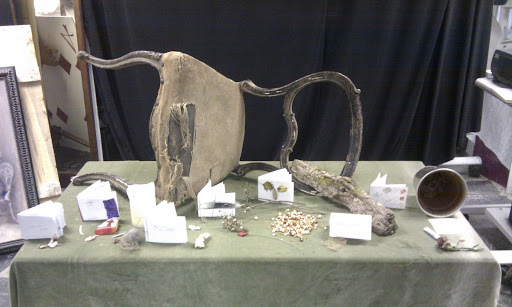
The whole event took place in an artist’s studio (the artist being Jake Spicer, who made a brief appearance at the beginning and impressed us with a tale of chasing off would be thieves with a mallet). Ellen led the session and she is likable, engaging and enthusiastic about sharing her knowledge. They had arranged a table with suitably Wabi Sabi items which we selected an item from to write about. (I chose a petal.)
One exercise was to write about something ugly, read it out and then rewrite it making the ugly beautiful. I find it way easier to write ugly than pretty. We were sent out into the corridors of New England House to look for suitably Wabi Sabi places to add post it note messages to. (A smell in a corridor that brings back memories, a face formed by screws, tiny port holes that reveal metered numbers, an origami person.) And again out at lunch to collect detritus that we used to create beautiful little booklets of fragmented prose and juxtaposed objects (stones, leaves, sticks, an iced gem that had lost its ice!)
We watched videos and listened to music. We discussed lost things and wrote about them. Wabi Sabi is about impermanence, insubstantiality, fragility, broken things, cracks, and the shine that can be found there. It’s a melancholy beauty I think, and ultimately it is death (maybe?). 
The session lasted 6 hours but the time didn’t drag or fly, it gently passed in pleasant reflection, knowledge and wordiness, and I came home with some new words, a hand made booklet, a cool new story idea, and a few new writing chums. Win!
I think there are only two sessions left but there will be more. Contact details and stuff is here.

And here’s the table of inspiration complete with our wee booklets:


IBRC Blog Award nonsense

Six weeks or so ago I received an email with a subject line “Blog Award Notice: Your Blog Has Been Awarded By IBRC”

Oh?

The email continues:


“During the month of July, the International Blogging Recognition Council (IBRC) had the pleasure of reviewing your blog A Salted.  Your blog was referred to IBRC through our Refer-A-Blog program.  “Sweeties Like Radioactive Worms” was the topic that the Council reviewed. Based on the review, the Council has recommended that your blog receive IBRC’s designation of “Recognized Blog”.  IBRC reserves this honor to those blogs that effectively connects with the audience and promotes the sharing of ideas and experiences.

We invite you to visit our website at www.ibrcblog.org to learn more about IBRC and our “Recognized Blog” award.  Congratulations on your accomplishment.”
Why, thank you IBRC. I wonder who nominated me.
Clicking on the link takes you to the site of the International Blogging Recognition Council. Sounds fancy.
And there one is invited to “Get Recognised” for the one off fee of $45.00.(Please read in sarcastic voice) A small price to pay for the right to put a button on your site that states you’ve “Been Recognised by IBRC”. 


They have a donate button which leads to this “IBRC promotes the belief that we are all one global community.  Below are several charities that are making a positive impact across the world.  Please consider donating to one of these groups.” And then list several known, good charities who I’m sure will not be pleased in being listed on this shonky site. I assume the presence of the charities is supposed to lull us into thinking good work is done here? 

Sounds like a right old lot of dodgy nonsense. I wish I’d got round to posting this sooner as I expect as many bloggers as possible were targeted. Hope nobody got scammed.


Posted in UncategorizedTagged

Psst! Wanna see my short story display case?

Regular readers will know that I occasionally post pics of “my” short story display case. (Of course, when I say “my” I mean books selected by me and displayed for sale at Waterstone’s bookshop in Brighton.)
So, here’s how it looks RIGHT NOW!
On the top we have Just When Stories all profits of which go to WildAid and the David Shepherd Foundation. Next up is Fame by Daniel Kehlmann, and then Stories to get you Through the Night which is the most perfect gift book I can think of. It’s beautifully done and offers quality stories from Katherine Mansfield, Alice Munro, Anton Chekhov, Oscar Wilde, Haruki Murakami, Wilkie Collins, Kate Chopin, Elizabeth Gaskell, The Brothers Grimm, John Cheever, Arthur Conan Doyle, Virginia Woolf, Rudyard Kipling, Helen Simpson, Richard Yates, James Lasdun, Martin Amis, Angela Carter, Somerset Maugham and Julian Barnes.

On the first shelf we have, as we always will as long as I am running this, the wonderful Collected Stories of Janice Galloway. I’m not sure if you’ll be able to read my review card in the picture, suffice to say I truly believe Galloway’s prose to be perfect. Next along is The Collected Stories of Lorrie Moore – another MUST for any short story fan. Then A. L Kennedy What Becomes (seriously people, this top shelf is chock full of awesome talent.) Then there is The Stories of Breece D’J Pancake, which contains the 6 stories published during his life, and 6 unpublished. It’s harsh knowing that’s all there ever will be. These are such vivid stories, rooted deeply in the place of his birth, rural West Virginia.

On the second shelf is Delicate Edible Birds by Lauren Groff,  The Bristol Short Story Prize Anthology 3 (which we had to reorder almost as soon as it came in!), Olive Kitteridge by Elizabeth Strout  and If I Loved You I would Tell You This by Robin Black (the title story is wonderful.)

The third shelf begins with Simon Van Booy The Secret Lives of People in Love which I haven’t read yet but am looking forward to, David Vann Legend of a Suicide which is one of those rare, special books that people urge on each other: Have you read? No? You should…
I have just added Virginia Woolf A Haunted House and other stories, it seems such an autumnal book. Then there is the inimitable (tho’ plenty try) Irvine Welsh with Reheated cabbage. 

The bottom shelf begins with The Collected Stories of Deborah Eisenberg, then the splendid Instruction Manual For Swallowing by Adam Marek, the much praised (and still on my list to be read) Everything Ravaged, Everything Burned by Wells Tower and finally Wilful Creatures by Aimee Bender.


Pretty darn enticing, huh?

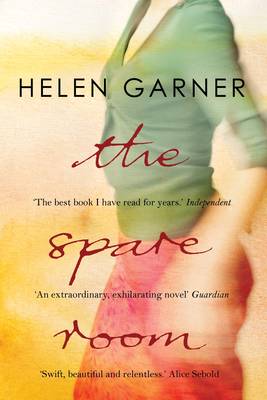
Helen Garner "The Spare Room"

I’ve just finished “The Spare Room” by Helen Garner. I knew that it was going to be a difficult read, how could it be anything but, telling the story of two old friends, one who is dying of cancer and sleeps in the other’s spare room for 3 weeks. The line between fiction and fact blurs – the narrator is called Helen, and Garner is known to have nursed a terminally ill friend. It is beautifully written and shines with truth.
Garner is apparently well known for her nonfiction and sometimes controversial journalism. She has said: “Writing novels is like trying to make a patchwork quilt look seamless. A novel is made up of scraps of our own lives and bits of other people’s, and things we think of in the middle of the night and whole notebooks full of randomly collected details.” I love this. It seems exactly what fiction is, a hodge podge of observations, musings and feelings.
In the novel Nicola goes to stay with Helen so that she can access some alternative therapy in a nearby clinic. Helen’s scepticism is the readers, we know there is not going to be a happy ever after. The prose is crisp and clean. There’s no sentimentality. The soaked sheets, wet with urine and sweat, the brutality of cancer, and Helen’s fury, are plainly writ. Nicola’s glued on smile and polite social face are irritating and endearing as she struggles to accept her approaching death.
Garner writes: “It was barely one o’clock and I was wide awake and staring-eyed. I thought I could hear movement in the kitchen, perhaps a voice murmuring, but it was a matter of urgency that I should get to sleep before two, the hour at which the drought, the dying planet, and all the faults and meannesses of my character would arrive to haunt me.” Oh yes, I know that hour well.
In the end the character Helen can’t bear to nurse her sick friend longer than the agreed 3 weeks, she is sizzling with anger and Garner bravely displays her flaws. She is human, as real as you and I. It’s a brilliant sad, achy, and honest book.


John Self at Asylum

I just realised that John Self’s Asylum blog was no longer in my blog roll. Because I always read him via Google Reader I hadn’t noticed but it must have happened when I changed design and lost everyone. Anyway, it gives me a chance to bring his excellent blog to your attention. He writes possibly the best book reviews on the internets so do check him out. You may not always agree with his analysis but I guarantee you’ll be impressed.

Asylum

In the absence of anything better:

I wrote a big blog post review and then realised the book I’m reviewing isn’t published until 2011 and it seems pointlessly premature to post. So, in the absence of anything better, I have decided to do one of those hahait’ssofunnyhowpeoplefindmyblog posts. I always like them. Which sounds sarcastic but isn’t – I really always enjoy them.

So, allow me to present in random order: –
“Louise Wener naked”  no explanation necessary.
“dirty tamil stories” which regularly appears!
“utterly alone” – how heartbreaking is that?
“pumpkins jim martin” is a perennial favourite as I once wrote a blog that mentioned the ex FNM axeman’s new life growing giant pumpkins and now seem to be a favourite stop off point for those who wish to do the same – hence the many variations of “world class giant pumpkins”.
“anal bashing” !
My number one search is apparently “Sarah Crowley” not sure who she is!  (Should I be worried that Sara Crowley is about 20 in the most popular searches this last 4 weeks. Hmm.)
“anti pickel” which I have no clue about.

The rest are all fairly standard.

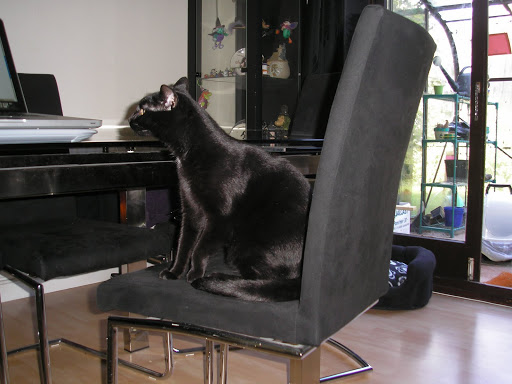
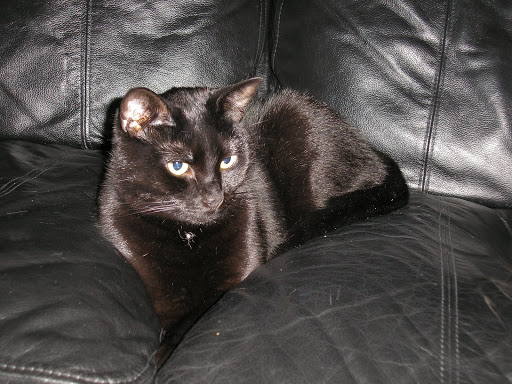
In other news we now have a kitty. She’s a rescue cat, two years old and her name is Princess. I have now christened her Princess Pancake and kinda dropped the Princess bit. So, looky looky here’s my cat and everyone likes cat pics right?

She’s fitting in nicely with what I do – just looking at the computer screen and not writing.