Not writing, just being.

I haven’t written for a few weeks. I should never stop, stopping fucks me up.

It was my twins 11th birthdays so I spent time shopping, wrapping, baking a disastrous cake, and my parents stayed for a few days, then it it was half term. School started back this week but my husband has been off sick with a virus. There have been lots of family gubbins, stresses, worries, grr’s. I had this idea that if I worked my way through my list of Things To Do I would clear space for writing and get back to it. My list is never ending. I cross one thing off and add two or three. I forgot that there is no space. I have to ignore all the jobs and write, dammit. So, today I sit down to do just that, words on a screen, no big deal. Only my health issues are flaring and my head is full of fucked up fuzz and not much else.

I shouldn’t have stopped.

But. Whispering somewhere in me is the idea that maybe I just shouldn’t have started.

There’s a gazillion writers out there, I’m not special, I’m not any whoop whoop talent. I’m out of energy. What if I stopped trying to write The Novel and just relaxed, played with words, enjoyed the creative process a bit more. But, then I’d hate myself for not finishing. God, I hate myself anyway, and I particularly hate that I sound so fucking whiny.

Best get on.

Magpies and shiny things.

The internet makes me so happy. Seriously, it’s all I dreamt it would be, and more. I went to a school which until the year above me had been a boys grammar school. Some of the teachers were misogynistic fossils who blamed the girls for the schools downgrading to comprehensive status. One of these men was the computer studies teacher. He didn’t believe that girls had the same intelligence as boys and directed his teaching only at boys. All I remember of his classes were diagrams of data, we never touched a computer at all.

I waited a long time to get my hands on a PC. When I did it was bliss. And it enabled me to get my writing out into the world. Through blogging I *met* other writers, made friends, learned, explored. Very cool. I’m self taught and probably go about things the wrong way at times, but I love how empowering it is. I persuaded my mum to get a MacBook, I think it’s an invaluable tool for older people and will help her retain independence.

There are some shitty things too. Online bitch fests, patronising people, twunts of all kinds. There are those who see other writer’s stories shining brightly and help themselves to ideas, layouts and themes instead of using their own imagination and fighting for uniqueness. (See Vanessa Gebbie’s latest post and Tania Hershman’s.)

I would like to say more about what I have been told has happened, but, ha ha, it’s not my story to tell, and I try to always be respectful to others stories. What I will say is that I am surprised at what it seems one can get away with. It would appear that one can take someone else’s stories and rewrite them, submit them, have them published, win money and acclaim, and then not be penalised if one hasn’t used the exact same words. Hmm. Sounds dodgy to me.

Also, reading up on plagiarism, it seems that it is not considered a legal problem, but an academic one. As such it is usually down to universities et al to dole out appropriate punishment. It is a matter of ethics, and when I share my work in progress with other writers there is an unspoken code of ethics which means we can trust each other. Sadly, just as in the Real World, some people are unethical.

There was apparently a huge plagiarism scandal in romantic fiction circles a while back. Googling took me to Smart Bitches, Trashy Books where what strikes me as most interesting is the amount of defending the people who shouted out about plagiarism had to do of themselves. Other peeps wanted them to shut the fuck up. Nasty business, move along now. But if it is not openly discussed how easy is it to move on? For me, unaffected by plagiarism (thankfully) it’s easy, but for the people whose work has now been diluted by repetition, whose trust has been shaken, not so easy I reckon.

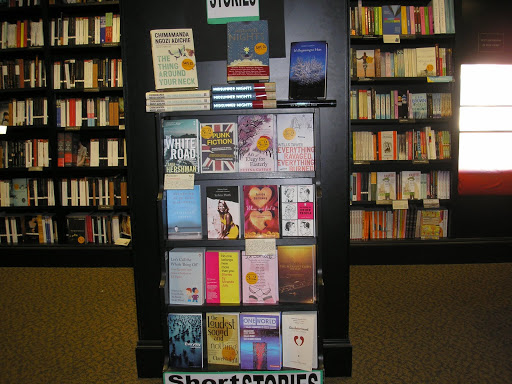
"My" short story display case!

I thought it’d be cool to show you a recent photo from the short story display case at work. There seems to have been a sudden flurry of very good short story collections being published. Hurray!

Starting from the top we have Chimamanda Ngozi Adichie “The Thing Around Your Neck”, “Midsummer Nights” edited by Jeanette Winterson, and James Lasdun “It’s Beginning to Hurt”(which looks excellent, though I haven’t read it yet.)

First shelf we have Tania Hershman’s “The White Road and other stories”. Tania was recently commended by the Chair of Judges of the Orange Award for New Writers who said “(her) work stood out for its remarkable quality. We look forward to seeing more of (her) writing in the future.”, then a really interesting anthology called “Punk Fiction” which features stories from a diverse range of people who were inspired by punk – amongst them Billy Bragg and Billy Childish, Kate Pullinger and Lane Ashfeldt. Next there is “An Elegy for Easterly” by Petina Gappah. You can read Vanessa Gebbie’s review of the book in this months Pulp Net. Also there is Wells Tower’s much written about/hyped collection “Everything Ravaged, everything Burned”

Second shelf features Eliazabeth Baines “Balancing on the Edge of the World”, Sylvia Plath’s “Johnny Panic and the Bible of Dreams” which sells well when in a prominent place. Perhaps people think Plath = poetry and The Bell Jar (incidentally, there is a new edition of The Bell Jar from Faber, it’s part of their 80th celebration, and I had to buy it just because it is so gorgeous. All of the Faber 80’s covers are scrummy.) Janice Galloway’s superb “Where You Find It” and “The Book of Other People”

The third shelf has “Let’s Call the Whole thing off: Love quarrels from Anton Chekov to ZZ Packer” – and includes a tiny piece from a writer I adore – Frances Gapper, as well as Ali Smith, Jackie Kay and Dorothy Parker, then deliciously quirky “No One Belongs Here More Than You” by Miranda July, “In Bed With…” full of anonymous sexy stories by well known authors including Ali Smith, Stella Duffy, Fay Weldon and Emma Darwin, and “The Pleasant Light of Day” by Phillip O’Ceallaigh.

The last shelf is rather cool, with “Everyday” by Lee Rourke, “The Loudest Sound and Nothing” by Clare Wigfall, “One World – a Global anthology” which I blogged about here, and Four Letter Word, which if I’m honest is the only thing not picked by me and has been replaced by
Lorrie Moore’s “Collected Stories” (a must) which is now available in paperback.

Phew – I have link fatigue.

Review of The Reader

I was sent a review copy of The Reader magazine a while back. I hadn’t heard of The Reader before so had a look at their site. They state that “The Reader Organisation is a charity dedicated to bringing about a Reading Revolution – we are making it possible for people of all ages, backgrounds and abilities to enjoy and engage with books on a deep and personal level.”

We run more than 80 weekly read aloud groups across Merseyside, in libraries, schools, GP surgeries, hospitals, Day Centres and workplaces as part of our Get Into Reading project
We were finalists in the NHS Health and Social Care Awards in January 2007
We run Liverpool Reads, a city-wide book bonanza which gave away and encouraged the reading of 13,000 books this year
We develop new culture-based social inclusion projects such as Community Shakespeare, Wirral which brought 1500 people into Birkenhead Park this summer
We publish The Reader magazine praised by Seamus Heaney as “one of the best things to thump through the letter box”
We’re turning non-readers into readers, one page at a time. What’s more, we’re connecting people, with each other, through books
The Reader Organisation is a charity dedicated to bringing about a Reading Revolution – this means great books reaching everybody – it’s our mission to engage people of all ages and backgrounds in sharing a wealth of literature. For us, reading is a force for social good that can build community and enhance lives.

The Reader Organisation works in four areas:

Reaching Out

Participation:
Get into Reading, our leading social outreach project, Liverpool Reads, Reader-in-Residence projects, and Community Shakespeare.

Training:
Read to Lead training is our accredited training programme for those who wish to develop Get Into Reading in other areas of the country.

The Reader magazine
The Reader magazine is our publication for established readers, encouraging wider and deeper reading.

We also have a blog to keep you updated with our news, book reviews, updates from the world of literature and a few, slightly more unusual things!

Reader Events
Our annual events calendar brings people together to enjoy live literature events, including the Penny Readings, Readers’ Days, Food for Thought, poetry and author readings. Keep track of what we have coming up using our Events Calendar and our News Feed.

Research and Development
Developing research through student participation; researching reading and health; delivering an MA in Reading in Practice with the School of English at the University of Liverpool.“

It all sounds terrific, and thoroughly worthy of support. I read the magazine a while ago, and intended to review it much earlier. The problem I had was that I wasn’t sure what to say. Did I like it? Maybe. How strange that I can’t tell. I loved the Camille Paglia poetry bitch fest, which was fun. The article was an extract from “Arion” so I’m not sure how indicative it is of usual Reader articles. It made me decide to buy Paglia’s “Break, Blow, Burn” though! There is a selection of good poetry, a few essays, reviews, a couple of stories, a crossword, a quiz, letters, an extract from a novel, and the final part of a serial (which having not read the previous parts I was not very interested in.) I am not sure who this magazine is aimed at. If the policy is to produce an accessible, intelligent literary magazine well, yes, this is. But who will be buying it? I wonder just how accessible and interesting it is to those who aren’t regular literary readers (it does suggest that it is for “established readers.”) It is a book rather than a magazine. It has a books price tag too at £6.95. I liked flicking through but didn’t engage much, and if I’m spending nearly seven pounds, well unless it featured favourite authors of mine I would perhaps buy myself a book instead. However, if I fancied reading a lively literary mix and maybe discovering interesting new writers, would I read again? Sure would. Would I like them to publish one of my stories in this gorgeous looking publication? Absolutely. Do I recommend it? I think so.

Matt Kinnison and the perfect coffee

Today is the first anniversary of Matt’s death. I was reading through our live journal looking for something and noticed that all of Matt’s cartoons have been removed. I suppose his photobucket account was wiped or something. It sucks to have lost them all. Anyway, I miss him like crazy, it hurts not having him in my life, and I send love out into the world to all his friends and family.

Thought it would be cool to share Matt’s perfect coffee (written in his own inimitable style) with you.

Here is a recipe for a most delicious Turkish Coffee:
Take four heaped table spoons of very finely ground coffee….whichever one you like best..it can be any type at all, with the possible exception of Kenyan, which may become overly acidic made in this way. A fuller bodied coffee, such as Mysore, Brazilian or Guatemalan works very well.
Add these to a small milk pan of cold water, so that there is slighty over three times as much water as there is coffee. Open three cardamum pods, checking that the seeds inside are black and podgy….the lighter, thinner ones are a bit like mouthwash and will spoil the taste. Add these and if you like sugar, add some now.
Bring this mixture to the boil VERY SLOWLY…just simmer really….bring to the boil three times, letting the mixture relax and simmer again between boilings. It should be on the heat for about ten minutes in total. A soft foam will have developed, and you should skim a bit off and put it in a pre warmed cup. After the third boil, pour the mixture in to the cup and leave to stand….there is an ungodly sludge that will need to settle, and you should remember not to drain your cup completely when you drink or you’ll get a faceful. This sludge, i am informed, can be used to tell the future, but i’m afraid i don’t know how.
This coffee is best served with something uncommonly sweet, such as Turkish Delight, A Danish Pastry or those Indian sweets that look like radioactive worms.

Les Murray

As mentioned previously, yesterday Les Murray was reading (and answering questions) at Goldsmiths, and I was lucky enough to attend. I was joined by Vanessa Gebbie, and although our journey there and back took several hours the time went super fast in her company. Thanks for coming Vanessa!

I first saw Les Murray 11 years ago at the South Bank. I was feeling unwell, strange, not myself. He read a beautiful poem about his son which set me chiming. A day or two afterwards I discovered I was pregnant. I therefore have long associated him with that huge life-changing event.

As Vanessa has said on her blog we both came away feeling inspired to stay true to ourselves. Les Murray’s voice is unique, and his presence, attitude and demeanour is refreshing, I can’t imagine him ever schmoozing anyone. He is a one off, a glorious poet, and an inspiration in many ways.

Review of "This is Not About Me" by Janice Galloway

It won’t surprise any regular reader of this blog to hear that I think Janice Galloway’s “This is Not About Me” superb. Despite it being published last year I have only just read it. I hoarded it like a rare treat, saved for a time when I could properly engage, believing that writing this good deserves attention. I have been pounding through umpteen books to review, and have deliciously come to a stop. Time for Janice.

There is a lack of family photographs bar the one on the front cover, so instead snapshots are created with Galloway’s customary precise prose. Rather than write with hindsight Janice the narrator speaks from her childhood, baffled by often cruel words and actions. She doesn’t qualify these things with an adult’s perspective, there is no summation, just a childhood up to the age of 12 told in scenes rich with the sounds, sights and taste of Saltcoats in the 60’s. Music, sweeties, telly, knitted clothes, chips, plants, and people conjured with descriptions as magnificently telling as “Sophie’s wrists were lavender, her eyes rimless, congealed as eggs.”

Janice managed life with a drunken father and an unhappy mother by being as quiet and as little trouble as possible. Her sister Cora was elsewhere, married and with a baby or babies of her own. After leaving her violent husband Beth Galloway moved to a cramped room above the doctor’s surgery she cleaned, taking Janice with her, and for a brief time there was calm. However, they were joined by Cora, now alone, much older than Janice, and full of unpredictability. Cora crackles off these pages, her beauty rituals and rage vivid. She terrorises Janice, her mother, and possibly the local men. She’s a kind of smoking, knitting queen, stationed in a chair, fag on the go, watching the telly, dictating to all and sundry, prone to alarming outbursts.

Janice begins school and learns how being good at tests isn’t enough, she is expected to fit in, to be cheery and make conversation. After school she sits outdoors, waiting hours for her mother to return home from work, making her own entertainment. Reading these clear slices of childhood made me long for a kindly stranger to befriend Janice, show her some affection and understanding, but none appears. It is an uneasy read. Knowing that adult Janice is one of the finest contemporary writers in the world and held in high regard is some comfort.

This is not a voyeuristic misery memoir. There are fleeting glimpses of love here, but it is awkward love, self-conscious and stiff. One of the saddest scenes has Janice saving money to buy her mother a present. She chooses with enormous care something special that she hopes will let her mother know how much she is loved. Cora ridicules the gift, and Janice, before it is given, and insists it be returned to the shop for a refund. Cora pulls her hair, bashes her lip, and Janice does as she is told and buys a pair of “safe” gloves for her mum instead. Ouch.

For the most part Janice observes, attempts to decode actions and anticipate the slight twists and turns of mood that can be the difference between a sort of peace or Cora raging at her, often violently. I was glad when she develops her own sense of anger towards the end of this volume with the onset of hormones. I wanted her to stand up to Cora, take the power away from her.

This memoir is a version of the truth, as all memory is. There are other sides to the scenes here, and as the title says this is not all about Janice. Here is Cora’s story, and Beth’s too. These three females cooped up together, struggling, each wanting something different. I would like to know more of them. As characters, for that is all they can be to me the reader, they are all three interesting. Looking again at the photo on the cover having read the book, the picture becomes perfectly symbolic of the relationships we have learnt about inside. I don’t know if there is to be a follow up, I certainly hope there is some kind of a happy ending.

EDIT: Now available in paperback.