Dogsbodies and Scumsters – stories by Alan McCormick and illustrations by Jonny Voss – review

Dogsbodies and Scumsters is a new short story collection from Roastbooks – a publisher that designs interesting and gorgeous books (Nik Perring’s ‘Not So Perfect’ for example.)
If I understand correctly, the Dogsbodies part refers to the longer stories, written by Alan McCormick, and the Scumsters are illustrations by Jonny Voss which McCormick has responded to. 
McCormick has an easy way with language. His characters sound believable even when they are doing unbelievable things, and they feel like the people we glimpse as we go about our lives. Maybe we warily keep an eye on the angry looking bloke in the pub, or cross the road to avoid that nice enough woman who seems a bit odd. Here McCormick gives them a voice. 
“Real Mummy” was, in my opinion, the most potent story here, and the narrator’s innocent voice recalling how her daughter was taken away from her is very powerful. I was glad to revisit the character in “Granny ♥ Terry Wogan” where her relationship with a taxi driver – 
Mister Haji – rings true. 
“…when you’re sixty all the streets look the same: dirty and full of ugly people with unwashed hair, clutching carrier bags and babies.”
“Howl” describes its main character, Eddie, a terrifying alcoholic bully, in such a simple, effective way that he remained in my head long after the story was finished. In “Deal or No Deal” Brenda’s kindest exchanges every day are not with her family but with the polite Mr Patel in the corner shop. It’s the plausibility that makes some stories so damn sad.
I didn’t get much out of the Scumsters parts. I like the illustrations, they are a fun way of letting some air into the book, but the accompanying prose seems a little throwaway in comparison with the Dogsbodies. They reminded me of writing exercises, but fans of the absurd will enjoy how McCormick has interpreted Voss’s drawings.


Link love

Two very different interviews and approaches – both enormously comforting to read –

David Vann at Helen Heath (Thanks to Emma Martin for drawing my attention to this.)

and

Jennifer Egan at Speakeasy

Highlights for me are pretty much everything Vann says, and this from Egan :

I haven’t had trouble with writer’s block. I think it’s because my process involves writing very badly. My first drafts are filled with lurching, clichéd writing, outright flailing around. Writing that doesn’t have a good voice or any voice. But then there will be good moments. It seems writer’s block is often a dislike of writing badly and waiting for writing better to happen.


Matt Kinnison

Matt died three years ago today. It seems a long time and no time at all. I have a glass of bubbly wine and I am toasting Matt and all who miss him. His friend Andie posted this track on her facebook page in memory of him – it’s a track that Matt wrote for Cindytalk and, as far as I know, the instrumentation is Matt’s and the vocals are Gordon Sharp’s. (If anyone knows different please let me know.)

Bookseller notes

The first customer of the day asks me where the book he has ordered is. I tell him it has not yet arrived. It has only been a day since the order was placed. He is furious, he yells, repeatedly points at me, yells some more.  “You are my target,” he shouts. “You are my target.” 

A customer asks if we have a novel by Vernon Little – something about a dog? I ask if possibly she means a book called Vernon God Little by DBC Pierre. She is adamant that is not it. It is by a man called Vernon Little. It’s about a dog. Could it be The Curious Incident of the Dog in the Night-time? I ask – knowing how unlikely that is. No. My colleague goes to the shelf and brings Vernon God Little over to the counter. That’s the one she says. No thanks, no apology.
A man is dragging his toddler down the stairs.
“Deal with it,” he says. “Get over it. That’s life.”
A woman asks for a book that may help her understand why three of her kids have attempted suicide. I don’t think there’s a book in the world that can do that. I recommend contacting CAMHS or MIND. She asks me if I can meet her for coffee as I’m the first person who has shown her any kind of understanding.
A young, beautiful couple come in and ask if we have a biography on a particular British actor. The man tells me he is a huge fan of the actor in question. I notice how he dresses like him and has similar stubble. Yes, a new biography is available and we have a copy on our third floor. The couple are elated. The man punches the air.
“I knew it,” he says. “I dreamt this would happen.”
“He does that,” his girlfriend says. “He has dreams that come true.”


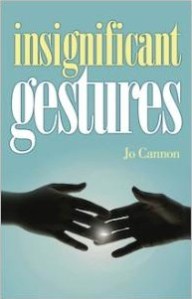
Review of Insignificant Gestures by Jo Cannon

The old advice to stick to what you know in writing is often ridiculed for its restrictive nature. I think, however, that Jo Cannon may well have written what she knows in her debut collection, Insignificant Gestures. Fortunately for the reader it appears that as a GP who works in Sheffield, who has worked in Africa, and who is a sensitive, intelligent woman, Jo Cannon “knows” rather a lot. 
The collection opens with the title story “Insignificant Gestures” which begins:
 “When I returned from Malawi I retrained as a psychiatrist. I never wanted to smell blood again, or the sweet nail varnish odour of starvation.”  
I thought I knew where the story was heading as the fictional doctor remembers Celia, the girl who worked as his servant and “came with the house that came with my job.” I was wrong, there is so much more to this than I expected, layer upon layer creating a whole world of connections, regret, devastation, ruin and death in just over 7 pages.
It’s a powerful story to follow. 
Human suffering hurts wherever it occurs, and that seems to be at the heart of this collection. Characters are displaced, or searching. Pain and grief are expressed without sentimentality. 
That’s not to say there isn’t much needed light and levity.
Aunty Doris is a wonderful creation who looms large in Evo-Stik and the Bigamist. 
“Subsisting on jam sandwiches and syrupy tea, she grew fat. Her legs like two elephant trunks, wrinkled and veiny, were permanently raised on a pouffe.”
And “New Look” features a protagonist whose sense of mischief helps highlight her own search for place.
In “The Alphabet Diet” Mick, the obese main character, loses weight in an extraordinary way. It’s a daft tale, probably necessary as contrast, but again is underpinned by a serious issue.
Some characters are created so deftly that the reader believes in them. 
Rosa in “Staying Power”  says:
“Wherever we go, we’re too many. In small spaces the children seem to expand, filling every corner.”
“No building contains us, we spill over. Other houses in the street hold three or four people, ours twenty or thirty.”
I saw Rosa, and her assortment of relatives. She is magnificent and I am glad that her story ends with hope.
Random observation – People run, a lot! I imagine that Jo Cannon must be a runner herself because it features so often. 
Jo has won many competitions with her stories and it has just been announced that “Insignificant Gestures” is on the long-list for the Edge Hill Short Story Prize (alongside Polly Samson, Vanessa Gebbie, Nik Perring, Susannah Rickards and Helen Simpson amongst others. Full list here.)


Female book reviewers and so on

I’ve recently read a few interesting articles on the subject of female book reviewing. The first was on Suzi Feay’s blog: “Where are all the female reviewers?” which was a response to a Guardian article by Benedicte Page on the dominance of male writers in the books world. The second was by The Independent’s Literary Editor, Katy Guest, who repeated Feay’s question here, which led to Feay posting a useful guide to being a “Great Reviewer”. 
I do wonder if men have more confidence in putting their views forwards. At the risk of generalising I think most men I know wouldn’t see being called opinionated as insulting whereas perhaps some women would see that as a negative? Amongst people I know “in real life” there are several film bloggers and several music bloggers, only one of whom is female. Does that mean anything?
I feel a little hesitant when I review books. I feel unqualified to offer my opinion as anything other than an amateur and despite being paid to review it has genuinely never occurred to me to offer a review to anywhere that has not asked. I used to imagine that as I am rather opinionated I would be unafraid to write the truth. Turns out that I hate the thought of offending anyone. If I read a book I loathe I prefer to keep it to myself. Or rant to friends. It goes against the grain to be so coy, my *thing* is truth. If I think a book badly written, poorly plotted and so on I tend to think, oh, it’s utter shit but someone spent time writing that and I wouldn’t want to upset them. What’s up with that? The younger me would scoff at this soggy old me. I even went so far as to set up an anonymous blog so that I could be honest secretly, but couldn’t even commit to that.
I have written gently negative reviews. Once an editor asked me to change one saying that they preferred to show more support for new writers, and a couple of times a different editor asked me to make a review more positive. Yesterday I read a brilliant review by Steve Finbow at Bookmunch. What a terrible review, how refreshing to read. I could never. Is that a gender thing or an individual thing?
I did once write a review here on my blog in which I stated that a particular book was such dreary toss I couldn’t comprehend how it was published. The author turned out to be good friends with a group of my online writing pals. I felt embarrassed and a little silly. Why? 
I’m wary of gender based assumptions but I believe that more women read men than men read women. Certainly in the bookshop a female customer is often more receptive to being shown recommendations from either gender than some men are. Does that translate to men not taking female reviewers seriously? Then we’re back looking at the whole industry which does not revere its serious women writers in the same way it does its men. Those literary heavyweights are always blokes, aren’t they? McEwan, Amis, Rushdie, DeLillo, Roth et al. 
Leyla Sanai reviews for The Independent and The Independent on Sunday:
I do think some men are, perhaps subconsciously, more dismissive of female opinions and female novelists. There was an interesting thread in a book forum I used to belong to where people discussed the male: female ratio of the books they read. I was one of the few who had pretty much a 1: 1 ratio, I seem to recall, and I still do – not because I consciously strive to seek out books by women but because I can’t imagine not wanting to read books by women. It’s always myopic to generalise but I think some male readers – and reviewers – aren’t much attracted to books that aren’t dynamically plot-based, or don’t play with language or meta-fiction or explore ‘great’ philosophical themes in life – sex, death, and so on. This has always amazed me: while many female novelists may not ostensibly tackle these major themes, many of them are just as (if not more) insightful in their writing about everyday life: family dynamics, relationships, parenthood, ageing parents, love, hate, and so on. 

That sounds like a gross generalisation because of course many women don’t write about these themes, and many men do, but I suppose people tend to write more about what they have direct experience of, and like it or lump it, many women do experience more of the interior of family life than many men, who have traditionally worked away from home. I just don’t understand how any reader, male or female, could fail to be blown away by the writing of authors like Maggie O’Farrell, Tessa Hadley, Julie Orringer, Rose Tremain, Hilary Mantel. It’s funny how the latter two only seemed to gain major acclaim when they tackled more ‘male’ themes – yet their books have always had that richness and depth, the insights, the wit and fabulous prose.”

I suspect that a woman is expected by some to only be competent in reviewing women’s books. Dismissed. Like Leyla, I read a mix – it’s what appeals, what’s good, etc, not based on gender of author. My favourite writer is a woman. That does not mean I’m not blown away by wonderful male writing too. Everything Leyla says rings true except my choice of strong literary women would differ from hers, showing what wealth of talent and variety of styles are available because…guess what…each woman is an individual.

Leyla Sanai says “Some (but not by all means all) men tend to dismiss any novel based around family life as ‘women’s fiction’. Of course there are many women who don’t like ‘domestic’ fiction, and that’s absolutely fair enough too. Personally, I get uneasy about categories: I used the term ‘domestic’ fiction in a Hadley review recently but made sure to use inverted commas because I was being semi-ironic – although her plotlines have been criticised by some reviewers as being too small in scope, I think what’s important is the writing, and whether a writer can bring a subject to life and make reading a joy. I have read some very poor family/relationship orientated fiction as well as much great stuff, just as I have read many brilliant novels based around intricate plots/adventure/action. Categorising is the enemy; some men won’t read books by women because they think ‘mothersandbabies/singlegirllookingforlove’. And that’s just so myopic. Personally, I wouldn’t read half of the stuff on bestseller lists in Smiths, and they probably include as much lightweight chicklit/’domfic’ as they do inane action thrillers like Dan Brown. What I was trying to say is that I don’t judge books on the gender of their author, nor on subject matter, but on the quality of the writing and the ability of the author to be intelligent, insightful, perceptive, smart, funny and original, and to bring characters and situations to life so that I’m completely immersed.

Some writers can make ironing hilarious, others render murder tedious.”


True, yes?


I suppose what is important is that opinions are expressed with spark and integrity. We need to be honest in reviews to inspire trust. I do think we need a variety of voices, male and female, so that we have a choice of reviews. It’s good to hear dissenting voices if there is a reason for that dissent but if it’s just ego wank it’s pointless. 
Thoughts?

Edit: Thanks to Jane Bradley for this pertinent link to an article she wrote at For Books Sake.


This is the bobbins part

Life is… challenging. Super challenging. It keeps getting shitter. It is heartsmash right now. Instead of gazing into the hell of it I am going to shine light on a few things that have made me feel a little less broken:

I am appreciating the blackness of the black finepoint Sharpies. It is difficult when the ink goes through to the other side of a page but the satisfaction of the deep black letters it forms is good.

I am enjoying way too many extra strength ibuprofen tablets. The ones I have are like Smarties: round, sweet candy for my near ever present headaches.

I love to hear anything from Kuzhali Manickavel because she is so much cooler than you/me/us. Her latest blog post includes this quote:
“Special salute to the lady assholes out there that remind us that misogyny is not a dude thing, it’s an asshole thing and just because you have a uterus does not mean you can’t be an asshole.”
Damn tooting!


I like how things are shaping up at HOUSEFIRE.


I’m reading the new Ali Smith novel. (Showing off.)


The Mentalist is back on. Hurray. Cho is by far my favourite character. I like his deadpan everything. Jane is aces too but Cho time is the best.


I have to mention that I’ve been entirely obsessed with Eminem’s Recovery. I am a feminist, unafraid to state that, and yet I’ve been listening to Recovery like I’m an addict. It’s hard to square that with myself so I don’t. I respond to the thrill of his speed, clarity, truths, wordblends, pain, melody and so on. It’s inspirational – he’s so, so good and I want that for myself. Whenever he appears with other rappers he seems to totally be better than them. All of them. And intensity – whooooo. 


No love is awesomeness. From 3 minutes in Eminem builds and builds and I love it just as much every time I hear it.


Things are coming back to life in my garden. I bought a tree last year. Well, it will eventually be a tree, I hope. Right now it’s a rather weedy looking couple of sticks but I can see teeny buds on those bare arms and I’m anticipating something hopeful.


I have a bird party tree in my front garden. Throughout winter I’ve put up fat snacks, peanuts, and seed feeders, and now it’s definitely a hang out. I like the sounds.

One thing vs. another vs. another.

Heavy demands on my time this year mean I don’t get to participate in online groups and discussions in the same way I have in the past. I do still google read many blogs but it’s easier to whizz through and kid myself I’m keeping up than stop and comment. So, I’m a lousy blog pal but I do still read, and I comment when I can.

A few posts recently interested me. One from Vanessa Gebbie’s blog entitledThe Thorny Issue of Writers and their Muses, and the Sex thereof…

I did write a lengthy response on Vanessa’s blog but it got eaten up not once but twice. Darn. 
She’s a skilled writer so I assume she made deliberate word choices here.

And Suzi Feay asked women writers to perhaps “…(take) one for the Sisterhood” over at her blog.


Interesting reading.