Freaky Friday

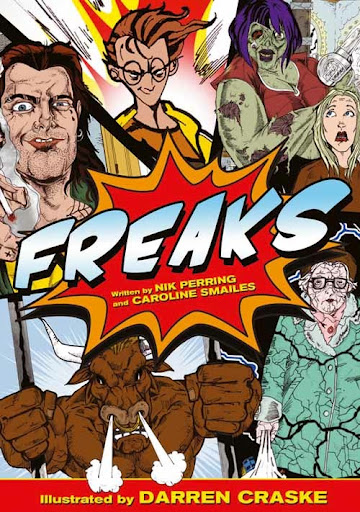
I’m a fan of Nik Perring‘s tiny fictions ( see here for my review of his debut, “Not So Perfect”) so was happy to hear that he has just published another collection, this time in collaboration with the totally ace Caroline Smailes:


Their press release explains, “Over fifty freaks and misfits feature in this unforgettable book. A unique collaboration between three popular writers, the stories are written by Caroline Smailes (Like Bees to Honey) and Nik Perring (Not So Perfect) and illustrated by Darren Craske, a comic book artist and author of The Cornelius Quaint Chronicles.”  


Sounds good, right? Who doesn’t love to imagine what their Super Power would be? (Mine is surely the ability to lose hours, procrastinate for days, and sleep for years.)


I’m impressed by how Nik Perring has managed to carve his way as a short story writer when we are repeatedly told how difficult that is, and he has kindly written this post for me to share with you:

Just a Short Story Writer
I’m going to start off here by saying that I’ve been very lucky. I’ve had three books published and two of those have been short story collections (Not So Perfect was published by Roast books in 2010, and Freaks!, a collaboration with Caroline Smailes was published by The Friday Project (HarperCollins) a couple of weeks ago).  And in a culture where (commercially, at least) the novel is king, I know that that makes me very lucky. 
I never set out to be a short story writer. I started life as a writer about ten years ago by writing things for newspapers and magazines. Then, in 2006,  my children’s book came out. All the way through I’d been writing short stories, and I’d had a bunch of them published, but I’d not considered myself a short story writer. I was just a writer who wrote short stories. And I wrote them because I enjoyed writing them. Same as reading them.
As time went on I wrote more and more short stories. I found the form suited me and the stories I wanted to tell, or maybe I suited the form. Either way, that’s what I did. And again, they were published and I was fortunate to have a collection out with the magnificent Roast Books in 2010, and then with equally magnificent The Friday Project this year.
So, while I wouldn’t say that I fell into short story writing, or that it was a happy accident, it wasn’t anything that I’d planned. It happened as it should have happened and that’s cool.
So how do I survive as a short story writer (a label which I’m getting more and more comfortable with) in a world where, commercially at least, it’s the the novel that’s king? I think the answer’s surprisingly easy: I survive writing short stories because that’s what I do, and that’s what I love, and I firmly believe that if you do something well, and if you work hard at it (any writing’s hard, not just one form) and if you get that bit of luck, then you can do okay at it. 
Don’t forget, people like good stories. Editors and publishers like good stories and readers like good stories. And that’s regardless of their length. Some stories are always going to be longer than others (novels), but if they’re good, they’re good, and that means they’ll have a great chance of finding a home and an audience.
Commercially, short story collections don’t sell as well as novels. We know this. Twas ever thus. And that’s not a problem (it is a Good Thing that people buy stories of any length). Nor is it the whole picture. Not every novel sells by the truck load, and not every novel reader will buy every sort of novel. And most novelists don’t make a fortune. They do what they do because they enjoy it, because they’re good at it and because the novel, as a form, suits the stories they want to tell. And they make some money from it. They probably have to do other things too to keep that financial wolf from the door, like editing or teaching or running workshops – or even jobs that have bugger all to do with writing. And that isn’t all that different to us short story people. We do it for the same reasons. We’re all writers. There shouldn’t be any us and them, or any prejudice because, really, we’re doing pretty much the same thing. 
So, how do I make it as a short story writer? Simple. I do what I love doing and I do it as well as I can.
Thanks, Nik, that’s a lovely, encouraging message actually – write what you love and do it well. I wish you every success.

I’ll leave you with a taster from Freaks, stories aren’t credited so the reader is left to guess which is written by Caroline or Nik – I like to think I can pick who wrote which but… hmmm, there’s no way to know which adds to the fun. Who do you think write this one?:

Invisible 
[Super Power: The ability to make oneself unseen to the naked eye]
If I stay totally still,
if I stand right tall,
with me back against the school wall,
close to the science room’s window,
with me feet together,
pointing straight,
aiming forward,
if I make me hands into tight fists,
make me arms dead straight,
 if I push me arms into me sides,
if I squeeze me thighs,
stop me wee,
if me belly doesn’t shake,
if me boobs don’t wobble,
if I close me eyes tight,
so tight that it makes me whole face scrunch,
if I push me lips into me mouth,
if I make me teeth bite me lips together,
if I hardly breathe,
if I don’t say a word.
Then,
I’ll magic meself invisible,
and them lasses will leave me alone.

Don’t be a twunt.

At after work drinks I was introduced to a friend of a friend. My pal gave a brief preamble saying we both write fiction and left us to chat. The guy said, “Oh right, you’ve had some stuff published, I’ve got stories that need publishing, where should I send them?”
I asked him what kind of fiction he wrote, what journals he read, who his favourite authors are. He told me he doesn’t read other people’s stories as they aren’t of interest, he doesn’t read literary publications, he just wanted to know the best places to send to and wondered if I’d make him a list as he didn’t want to waste his time.
I told him to check out Duotrope. I felt awkward, I didn’t feel it was appropriate to get into just how arrogant I thought his attitude. It has stuck with me though and I wanted to address it here. His sense that those journals would be lucky to get their hands on his words was strong. Even if he’s an amazing writer (which I really doubt) the attitude that people should read him but he will not offer the same courtesy, stinks. 
I’m a writer who loves reading, is there really any other type? I read widely online and the high standard of many literary ‘zines stuns me. I subscribe to a few journals, to keep in print they need support, if you ever hope that a print magazine will want to take your words and other people pay to read them, you could buy that magazine yourself occasionally, right?
I try to keep up with blogs and read the stories that Facebook & Twitter pals link to. I give a cheer out every now and again. I’m not insincere though – I don’t go down a list going likelikelikelike. I’m not desperately trying to schmooze people, if I like or link it’s because I mean it. 
Last year Matt Bell gave an interview in Ploughshares  in which he said:
“I think the big mistake most writers make is thinking that becoming involved in your community is something you do after your book is published. Instead, I urge writers to become involved as early as possible, in a genuine, non-book-related way. It’s always a little off-putting when a person suddenly becomes interested in book review venues only once they have their own book. In a similar way, it seems false to only be interested in independent bookstores when you’re trying to get your own book stocked. The better solution is, as a part of your daily work as a writer, support the communities you wish to be a part of, by reading books, writing reviews, promoting other writers or bookstores or whatever in your social networking. It’s a small but old truth, but the more you give, the more you will receive. And this isn’t any kind of slimy networking. This is every writer’s responsibility, and the writers who create the most buzz for the good work of others will find that same energy waiting for them, when their own excellent book finally comes out.”
I love that.
I try to do my bit, small as it is. I critique for some writer pals – I’m happy to do that, glad that they respect my writing enough they think I can help. I belong to a really good (tiny) online group and we flash together, offer thoughts on each other’s longer fiction. I’m lucky that if I need someone to look at a piece of mine I can turn to a few truly amazing writers and ask. 
I’m proud to be a first reader for PANK. They are an awesome journal and it’s an education reading the submissions they receive. (By the way they were recently mentioned in The New York Times – that’s how fucking cool PANK is. If you’d like to support them they are having a Spring Funds Drive and would really appreciate any help.) 
I often get asked to review. I’ve spoken about my wariness before; as I’ve got older I feel I have more respect for other folks endeavours and less inclination to put anyone down. If I hate a book I prefer not to mention it. If I like a book I’ll happily say so here on my blog, on Facebook, at work and so on. My bookseller recommendations are genuine. I LOVE to talk about great fiction, I’m thrilled to see a customer buy a book that I think highly of. When I was young I was hugely opinionated and very sure of myself. I would happily give my thoughts on anything and everything, but now I’m older I realize how little I know, how subjective everything is. I enjoy reading other people’s thoughts but my own often seem flimsy. I find it easier reviewing books by people I don’t know, preferably “names” so I can tell myself they won’t be affected by what I think. It’s the debut collections and novels that worry me. I don’t want to cause offence. With age has come an excruciating politeness. It’s not ideal for a reviewer to feel that way. I am sent heaps of books I think are ok. No better than that. I read many story submissions that are ok. I want to be dazzled but it’s a rare occurrence. One can’t simply review a book and say, “This is okay,” it wouldn’t tell anyone anything, and yet I keep feeling that’s all I have to offer. I’m trying though to be the best and most honest reviewer I can be and to say what I mean without being a rude bitch.


I get to do cool stuff at the bookshop. I support good writing via recommendations, readings, reviews, displays and promotions. I think I put a little back into the world I want to be part of.  
Sadly I’ve been getting increasingly fucked off with the bad manners some writers have. It’s bad enough at work dealing with the occasional deluded writer (the self-published man who wanted me to order in his £20 hardback, 1 in a series of twelve self-published novels he’d written in the last two years, for example) but it’s part of the job I am paid to do. I’ve lost count, however, of the number of times I’ve been approached as a writer by another writer. We become friendly online or in person. Then, oh, their book is published, or due to be, and they wonder if I can get it into Waterstones? Can I review it? Can I organise an event? Then when I’m no longer any use to them they vanish. I try not to take it personally, I know how hard it is to get published, to get sales, publicity, etcetera and I really do want to help promote good words. It’s not wrong to ask if I can review and so on, but it is wrong to pretend to give a shit about me personally if you don’t. It’s really fucking rude. Please do consider when approaching someone, a nonprofessional, if your intention is simply to get them to do a particular thing for you. If so, why not ask directly? I’d much prefer to be asked “Can you review my book?” and offered a copy than be schmoozed for a while. The fact is I often give my review/critique/whatever for free. It’s a goodwill thing. If you are paying for my reviews/critiques you have every right to expect it to be a transaction but if ostensibly we’re writer chums and you ask for a favour and then disappear please know that I think you’re a twunt. 


I’ve been feeling embarrassed about the fact I have sometimes felt I’m making genuine friendships, y’know, I’m a writer, they’re a writer, we’ve got stuff in common. We chat, email etc,  I take things at face value; we seem to be getting on then, erm, we’re getting on, right? When I’ve ordered the book in, reviewed it, time passes and I think, hmm, whatever happened to so and so? And it hits, the realisation that, shit, it was another one of those networky things. I feel foolish at best and genuinely upset at worst. 
Oh, and if you bad mouth someone to me and then I see you Twittering all over them I not only feel uncomfortable, I also assume if you do it to them you’ll do it to me too. Ugh. 

Kill Author – Dorothy’s Shoes

I’m pleased that Kill Author have published “Dorothy’s Shoes”. My flash is an entirely fictional account of the suicide of Dorothy Edwards. The actual details known about her life, writing, and suicide are the kind one does not forget. Her suicide note is shocking. I keep wondering what happened to her shoes.

I’ve had several responses to this piece from people saying they had not heard of Edwards. Her one collection of short stories – Rhapsody, and her only novel – Winter Sonata, are usually available from Waterstones Brighton and are well worth reading.

Vanessa Gebbie and The Coward’s Tale


The Coward’s Tale is published today in paperback format. Vanessa Gebbie is embarking on a blog tour to discuss all kinds of things about it. I knew others would focus on various craft aspects, publication, place, story and so on, and ask many intelligent, thoughtful questions. But would they ask about sandwiches? Aha! I will fearlessly go where others have not… 


Hi Vanessa, thanks for dropping by. I thoroughly enjoyed  The Coward’s Tale, the vibe is different to most novels I read. It’s poetic, thoughtful, melodic, it felt like I was reading a “classic” novel. There’s a sense you’ve built something to last. Was it always your intention it would feel like an older novel or did it grow to be that way? 
That’s the best bit of feedback a writer could get. Coming from a Waterstones bookseller, even better. YAY! That’s almost enough to make me get out of bed. (No nothing exciting, sorry. Flu…) I didn’t expressly guide it to feel like a classic –  or older novel (if they are the same…) but I guess I wrote the sort of thing I could stand to inhabit for five/six years. Maybe that added up to classic/older? 

The language, of course, puts me in mind of Dylan Thomas’s Under Milk Wood. You mention a character borrowing his book from the library, and I presume The Cat pub is a nod to Captain Cat? Any other references?
Good. I am glad. The language in ‘Under Milk Wood’ is wonderful. So is the language in a book by another iconic Welsh poet, David Jones – ‘In Parenthesis’. Of the two books, the latter is vastly, but vastly superior. It is a poem, a play for voices, a novella…it certainly influenced Thomas, and they both influenced me, but in different ways.  
I believe DT even took a part when ‘In Parenthesis’ was recorded for the radio – but then someone can tell me I’ve got my facts wrong, and I won’t be upset. Timescales certainly mean Thomas knew ‘In Parenthesis’ well.  Jones fought in WWI, and it tells the story of one battallion up to and including The Somme. It is raw, dark, beautiful, true, ironic, can be funny in places untiul the main events loom –  But when Thomas went to write his own poetic play for voices, he wanted (again, I believe…) to react against the horrors of war, in his case, WWII. Under Milk Wood was deliberately light, pretty, quirky, but some might say it is a bit unkind…  and it portrays a vision of Wales that never existed. He did well out of it, though – so much so that give anyone a bit of Wales, and a bit of lyricism, it has to be thanks to UMW.
I wanted to write this novel, set loosely in Merthyr Tydfil, a town in the s Wales valleys, because I loved going there as a child, and my parents’ love for the place never diminished. I wanted to go further than portraying a Wales that never existed. 
The Wales I was brought up with is the Wales  that did exist, in which one great grandfather went to work down a coal mine aged eleven. His job was to hold the ventilation doors open or shut, often knee-deep in water.  Family history says that when his candle went out (as it did, soon enough every day, in the draft) he was in the pitch black, except when a collier stopped for a word. 
Its a Wales where the town that gave my parents life  became the subject of a House of Commons Debate – because of its appalling health record (cholera, typhoid, malnutrition,) they at one point considered raising it to the ground and shifting the population to the coast. The town that had at one point been slap bang at the centre of the coal and iron industry. 
The Wales I was brought up with is the Wales where the Depression hit like a great fist in an empty stomach, where my adoptive mother and father  were unable to stay if they wanted good jobs.  And where we went back to, as often as we could, to be with the grandparents, uncles, aunts cousins – because it was ‘going home’. 
Contemporary writing centred on towns like Merthyr so often portrays the issues stemming from some of the highest levels of unemployment in the UK.  Drugs, crime, grit. I didn’t want to, and couldn’t, add to that canon. 
Anyway, I’m drifting. Did you pick up an emotional thread there? Ha!
From DT I learned to create a community out of actions and voices. From David Jones I learned how to be true to something – to create not just a troubled community, but the darkest of days in its past, not flinch from looking it in the eye, while trying to make the darkest of days still darkly beautiful.
And from my mother, a librarian, and my father, who was decorated in WWII, I learned the rhythms of speech of the valleys. That never left them – my dear Dad was still recogniseably a boy from the valleys at 95. All I had to do was recall the language of my grandmothers, her neighbours, and the direct speech was there. The banter.
“Lily? Where’s my hat?”
“Last time it saw it, was on your head, Ethel…”
“I must have put it somewhere..”
“What – your head? Duw, there’s athletic. Arthur! Can you find Ethel’s head?”
On occasion, it got overdone, mind you – and a lot of work went into smoothing it out! 

Wonderful answer. I must confess to not knowing David Jones – I’ll have to check him out.

I love the names and the nicknames. 

Good!
How did you think of them? 
Helped by the characters themeselves, as ever – a character doesnt ‘feel right’ to me, and I can’t write them out, until they have given me their right name.  Anyone else like that out there?
If you lived in the village with your characters what would your nickname be?
Batty Vannie, I expect. 
You have to spend a week with just one of your characters. Which one and why?
Oooh, what fun. Hmm. Peter Edwards. I want him to teach me to listen to the stories in stones.

The novel is full of stunning, evocative writing.
“When the wind is in the east, coming just steady over the coal tips, the tunnel near the Brychan sings like an empty pop bottle. The sound bells about the soot and bricks as if it’s caught in the throat of a Dowlais tenor, coaldust and all, then it spills out and flows down the alley to the town. It settles in the alleys between the houses, seeps through the gaps in the windows; a hooooooing that has children crying there’s ghosts in the chimney.”
(Page 239 of the hardback.)
Thank you. 
Was it hard to maintain the voice?
In a way, that’s for others to say. Those lines are from the very first section I wrote, now called The Clerk’s Tale – and I didn’t think about what I was doing – the voice was just that of one story.  But of course, after that story did OK at a few places, and as I was encouraged to write it as a novel, I  did become aware of what I was doing, and that is fatal. With the next piece, I went right over the top, and the voice became more like a concrete mixer full of reversals – and I had to do a hatchet job, and get back to more normal-sounding rhythms. I kept in the odd nod to my family phrases. ‘Nowjust’ was one of my grandmother’s words..
“Cleaned your teeth lovely girl? Off to bed then, I’ll bring up some sweet cigarettes nowjust – when Coronation Street is finished…”
I used to smoke ten before going to sleep. 

Did you read aloud? Did you reject non-poetic sentences? 
Yes. Always. I spent the second week of a two-week stint at Anam Cara  reading every sentence of the first completed draft out loud, editing for rhythm and sound.  I wanted the whole thing to have the feel of a poem, or something. 
I noticed that food features quite often so I have devised a foodie section for the interview.
Yum!
Sandwiches are mentioned throughout so here’s a sandwich section:

What’s your favourite sandwich? 
Mashed banana and brown sugar, with a cuppa.  
White/granary or brown bread?
White.
Butter/spread or none?
Butter. 
Mayonnaise or salad cream?
What, with banana, are you nuts?

What are your feelings on sandwich paste and sandwich spread?
Paste, NO NO. Sandwich Spread  YES – but as it was. They’ve changed the taste. This is another nod to family memory – I used to live on sandwich spread sarnies at my Nannas, and spent ages picking out the little ball things –  I think they were mustard seeds. I fed them to the budgie.

Beetroot – yay or nay? 
Yay! And with cold lamb too. Wonderful combination.
Ianto Passchenaele Jenkins takes payment of toffee (and other confectionary) for his stories. What would your sweet payment of choice be?
The same as his. Toffee, or Spanish. (Liquorice).

Page 251 (of the hardback) has a beautifully telling description of Tommo Price’s tea. It says so much about his wife, Sarah. I think you have a very deft way of revealing character.
“… Sarah Price, who makes white fish for tea with white buttered bread and serves it silent. Lardy-faced, she is, and secrets slide from her like dropped bullseyes on a frozen puddle.”
What teas would you write for David Cameron and Barack Obama? 
If the cameras were invited in to No 10 to watch tea time with Obama,  they’d have:
Brown boiled eggs and granary soldiers. And at some point, Cameron might say ‘oops, its an egg, you know, not brown because of anything, um, snort, (Eton snigger…) would you prefer white?’ But he’d give it a good bang on the head with a spoon anyway.
They’d have a plate of jolly good British cakes, Eccles, Dundee (well, British for the moment) Chelsea buns (he’d dip those in his egg). He’d also have Welsh cakes but Samantha would say what’s those darling, and he’d hum and ha and slip them to the dog. He’d have a packet of Yorkshire teabags in camera-shot on the side, Cornish butter (hand- churned by the Duchess of Cornwall). 
And when the cameras  and the Obamas had gone, they’d clean their teeth and start again with caviar on blinis and call up Osborne to call by and bring the bubbly old chap, let’s sell the roads to the Chinese by six, and don’t tell Cleggers.

Well hush ma mouth.

I’m struck by some of your vivid descriptions. 
“… go back up to the Reading Room, where one of the strip lights will be flickering and buzzing like a caught wasp.” I was delighted by how exact that description is. Is it something you’d noticed before and tucked away to use in fiction or did it come to you as you were writing? 
Not specifically tucked away. I suppose when you are really inhabiting the world you are creating, you experience things in a very ‘real way’ –  so they come bounding at you with great clarity.  We’ve all heard and seen those strip lights!
Are you a notebook carrier, always scribbling details down for future? Or?
Yes. Although usually, when a thought of great genius arrives, I’ve left the thing at home, and can’t find a pen. So I go into the nearest Smiths, and buy another – by which time I’ve forgotten the idea in the first place. Story of my life. But yes – I’ve usually got a pen/pencil notebook somewhere.
Do you see another novel for the world you’ve created? 
What do you think happens next for Laddy. (I loved the relationship between the boy and the older man, by the way.)
I am  glad of that feedback, S, really.  The next novel will tell me what happens next. And quite possibly, what happened before, as well. Ianto and Laddy are the main characters. Fathom that one out. 

I’m delighted to hear that I’ll be able to read more about Ianto! Excellent news.

Bloomsbury have given me a copy of the paperback to give away. I thought it might be fun to get people to describe the tea they’d imagine a famous person to eat in the comments and you could pick your favourite as the winner?

Brilliant idea – only the person must have some link with Wales. Dead or Alive. Howzat?  
Sara – thank you so much for letting me perch, and for coming up with such yummy questions. 

My pleasure, Vanessa. 

Right then, if you’d like to win a copy of The Coward’s Tale please do describe a tea that a famous Welsh person (dead or alive) might eat and post it in comments and Vanessa will choose the winner in a weeks time.

The Coward’s Tale tour continues at Claire King’s blog and Tania Hershman’s where you’ll be able to enjoy a far superior style of interview!

We The Animals by Justin Torres


There are expectations when one reads a book published by Granta and endorsed by literary luminaries such as Michael Cunningham and Marilynne Robinson, especially when one of those endorsements suggests, as Cunningham’s does, “It resembles no other book I’ve read.” My manager recommended it to me. She reads a gazillion books a year and thought it was pitch perfect. So, the hype is high.
It’s a slender novel, only 125 pages, and yes, it is different.
The novel begins “We wanted more. We knocked the butt ends of our forks against the table, tapped our spoons against our empty bowls; we were hungry. We wanted more volume, more riots. We turned up the knob on the TV until our ears ached with the shouts of angry men. We wanted more music on the radio; we wanted beats, we wanted rock. We wanted muscles on our skinny arms. We had bird bones, hollow and light, and we wanted more density, more weight. We were six snatching hands, six stomping feet; we were brothers, boys, three little kings locked in a feud for more.”
The voice is the “we” of the title, a trio of brothers, and the use of “we” is impeccably done. We, the reader, are drawn into the “we” of the brothers. Theirs is a life of poverty and deprivation. Dad, Paps, is a bully; a menacing presence capable of unpredictable tenderness and plentiful beatings. Ma is victim and hope, receptacle for anger and frustration. She endures at the hands of the males in her life, she tries to fight back, but loses. “We” are three wild kids, rampaging, flipping the finger, smashing things, fighting, scrapping and eating like animals, (erm, yeah, “We The Animals”). Torres writes violence and poverty in a darkly poetic, compelling way. 
The narrator is the youngest brother and he is identified as different by his mother from the beginning. In the end his difference causes, inevitably, the “we” to become “I.”
That’s where the novel lost some of its power for me. I think perhaps the division felt too sudden, too fast. The vignettes had led me to think he was very young, and then a little older. The conclusion seemed abrupt, the narrater much older. It’s a shocking ending. One which perhaps didn’t feel entirely organic. Then yesterday, after I had written this review, I read an article in The Guardian by the author, and the reason the ending didn’t feel as pat as storybook endings often do is because it is a version of his truth. This happened to him. (I try to avoid spoilers on this blog and if you’d rather read the book with fresh eyes maybe avoid the article, however, had I read it in advance it’d undoubtedly have changed my understanding.) 

Somewhere Else, Or Even Here by A.J Ashworth

A.J Ashworth won Salt’s Scott Prize to have her debut collection published. “Somewhere Else, or Even Here” contains 14 of her stories. I’ve taken my time reading this as I found it best to read just one tale at a time and savour.
This is a good collection. Ashworth does very well with conjuring place and people. Her stories are full of evocative details even when describing mundane tasks such as putting tools in the back of a van and starting it up: 
“…he laid his tools down in the back like they were offerings to the gods of work; stained and dirty offerings which had never yielded any blessings. Then he got behind the wheel, started up the engine and watched as the windscreen heaters blew air onto the tracing paper frost, making a glassy stain build and grow there.”
Astronomy is a recurring motif with characters studying the subject, having star tattoos, sending Chinese lanterns into the sky, having moon faces, gazing upwards, talking about the universe. It’s not merely the repetition of stars/planets/sky that unifies the stories, some of them feel related by character or theme despite the diversity of subjects. “Bone Fire” has a first person narrator who recalls Jeremy from the opening story, “Sometimes Gulls Kill Other Gulls.” I wondered if the woman from “Offerings” was another perspective on the story “The Future Husband.” “Paper Lanterns” has a zanier counterpart in “Bananas.” 
“Paper Lanterns” was a story I found  a little obvious, although if one were to look for a textbook “good” story it ticks all the boxes.  It describes the aftermath of a child’s death, but does so in an expected way. “Bananas” took an entirely unexpected approach to a similar event and was all the stronger for it. 
Occasionally I knew I was being expertly manipulated. Ashworth has excellent storytelling craft and knows how to mine an emotional seam. Loss, death, grief, illness, fear, are all here. I favoured the stories that caught me unawares. Despite how solid “Eggshells” and “The Prophecy” were, I had an understanding of them from the outset. Of course, one can still admire a familiar journey, and I did.
I didn’t understand what was happening in “The Future Husband”, or how it could resolve. It worked superbly; it was tender, note perfect, impossible. “Coconut Shy” was wonderful in its dealing with burgeoning sexuality and a disappointing beau contrasting with the older, experienced fairground worker “…who strolls from around the back of the counter, smooth and slow. Jimmy shifts to one side, looking thin and unsteady as a daddy-long-legs beside him.”
I think Ashworth is a writer who has much to offer and I thoroughly recommend her collection. I look forward to reading more of her in the future. 


A leap year story

Calum Kerr, the founder of National Flash Fiction Day, has apparently limitless enthusiasm for the form of flash as he writes one every day on his blog “flash365”. When he realised his aim to write a flash for every day of the year hadn’t factored in the 29th February he invited other writers to send in stories, and he posted one an hour. Consequently, lots of tiny fictions are available for your reading pleasure.

My flash – “Disappearing Day” – can be read here.

National Flash Fiction Day Competition

I love flash fiction when it’s done well, where every word counts and a life is glimpsed, and I was pleased to be one of the judges for this competition. There were almost 300 entries and every one was read by each of the judges. The winner is a fab story by Angela Readman – “The Worst Head in the World” and the Top 10 list (which can be read here) features all kinds of excellent words. Go, read, enjoy.

Edit.
Just to clarify – all the stories were anonymous; names were taken off and formatting made identical by Calum Kerr before he sent them to the judges.