All Fours by Miranda July

Miranda July is always interesting and writes with appealing and strange honesty. To read a novel where the narrator is an intelligent middle-aged woman , independent and even (gasp) sexual, is a treat. How many novels have been written where an old male professor of literature or similar has an active sex life with a younger woman – yawn. All Fours shouldn’t feel so unique but is. The narrator is supposed to go to New York for a 3 week work trip and is persuaded to drive – road trip! Instead, she only makes it to a nearby town where she spots a handsome young guy working in Hertz. She holes up in a motel for the night and then…  just stays.

This quote stopped me and had me sending it to my pals in one of those glorious connection moments with the note “THIS! Exactly this” – “If birth was being thrown energetically up into the air, we aged as we rose. At the height of our ascent we were middle-aged and then we fell for the rest of our lives, the whole second half. Falling might take just as long, but it was nothing like rising. The whole time you were rising you could not imagine what came next in your particular, unique journey; you could not see around the corner. Whereas falling ended the same way for everyone.”
This is a novel about someone examining aging, being a mum, wife, creative artist, friend, taking pause to look at who they are and reconnecting with themselves. It’s also about a peri-menopausal woman having a fierce crush and exploding into their desires.

 I mean, it’s bonkers and all written from a point of monied privilege: the narrator can afford to take this time for personal growth and exploration thanks to a wealthy husband and personal success in an opaque arts related field,. They can leave their child and husband for 3 weeks and then reshape their life. They can pay to have a shabby motel room redecorated in an expensive plush replica of the fanciest of hotel rooms. It’s not relatable. Her lifestyle doesn’t have to be though, it’s enough that these thrilling words are written. The ending wasn’t satisfying for me, but who cares? I love that July writes this messy, complicated, eccentric stuff. Long may she continue.

Our London Lives by Christine Dwyer Hickey

This is one of those delicious immersive novels which saw me both reading late into the night unwilling to leave the story, and putting the book down to wait to finish it because I didn’t want it to be over. I loved the two main characters, Pip and Milly, and it was a pleasure to watch them weave in and out of each other’s lives over the course of 40 years; their stories told in alternating chapters. London is the third main character, its contrasting riches and squalor so much more than a mere backdrop as Christine Dwyer Hickey shows us buildings, architecture, gardens, riverbanks, and squats; the developers who tear down and rebuild, and the people who live, work and visit. This has everything I look for in a novel, incredible writing which draws you in and makes the fictional world real, interesting characters with depth, an insightful look at what it is to be human, and a real sense of jeopardy as these two troubled people navigate poverty, trauma, addiction and hope.

 Beginning in the late 70’s Pip and Milly, two young Irish people who have moved to London, meet in a pub. Pip’s a promising boxer with a taste for drink, and Milly is a live in barmaid. There are several well rounded and fascinating characters that surround them through the years – Mrs Oak the pub owner who takes Milly in, Trish, another barmaid, Dom, Pip’s older and more successful musician brother, “… it’s not that he doesn’t love his brother, it’s just that he can’t fucking stand him.” and Dom’s son, Max. Even those on the periphery feel real, their conversations natural and distinct. I bloody adored this.

When We Were Silent by Fiona McPhillips

If you keep up with book buzz you will have already seen so much about When We Were Silent, the debut novel by Fiona McPhillips. Nobody needs a review of it by me – Steven blooming King just recommended it. Nonetheless, here I am joining in.

Decades ago, Louise Manson, a seventeen-year-old schoolgirl, was admitted to a posh private school hoping to avenge her best friend’s death. Suddenly surrounded by entitlement borne of wealth (while at home her mum is desperately in debt) Lou tries to navigate her way to expose the abusive swimming coach. The details of the time, the music, posters and chatter of young girls, is keenly observed, and the intensity of feelings seems very real.
In the present day Lou is called to give evidence in a young boy’s case against a swimming teacher. I don’t want to spoiler anything so won’t say more than When We Were Silent is a gripping and tense tale that feels grimly plausible. McPhillips ramps the tension up and this becomes a real page turner as we read on to the thrilling conclusion.

Ootlin by Jenni Fagan

I’ve been a fan of Jenni Fagan’s writing since her 2018 debut novel, The Panopticon, was published. Reading her memoir, Ootlin, it’s hard not to draw parallels between the central Panopticon character, Anais Hendricks, and Jenni Fagan herself; both fizz with intelligence, both born into a care system which is anything but. Ootlin is an intensely personal book (which began as a suicide note). It’s distressing and vital; vividly written, poetic, brutal. I was completely absorbed and horrified and sad, yet it’s a page-turner despite being a hard read. We follow Fagan from birth through a childhood spent in a succession of foster homes. There is so much cruelty. So much. It’s unbearable. I’m in awe of the absolute strength and skill it must have taken to write this book. Knowing that Fagan is an artist and writer with a successful career was the much-needed light guiding me through. What a life she has endured. What a triumph her survival in spite of it all is.

“…what we are living through is not a thrill, it’s not a story, it’s not a buzz, it’s not a joke, it’s not gossip, it is not a story that other people tell, it’s not words on a file or spoken in the kid’s court, it is a dense thud of silence when we walk in a room, it is not a bet someone will never win, it’s ambulance doors swallowing me overdosed at twelve years old and ready to die because of what I have already lived through – it is real – we are trying to survive the unsurvivable and none of it is stacked in our favour and it is all totally against us.”

Strong Female Character by Fern Brady

I love Taskmaster – it’s the perfect daft and gentle antidote to the stress and worry and sadness of life. The five contestants are usually a good mix of familiar and new funny folk and series 14 was my introduction to Fern Brady. (Incidentally, what a great series 14 was – it was also the first time I saw John Kearns who was fantastic – I already liked Sarah Millican and Dara Ó Briain.) Fern was immediately appealing. She has this absolutely gorgeous raspy Scottish accent, her make up and clothes were colourful and she’s refreshingly blunt. I didn’t know that she was autistic until I started following her on social media. Strong Female Character is the perfect title for her memoir – it’s so exactly who she is. It shouldn’t be surprising to read such an honest account and yet it is. Crikey, I wish more of us were courageous enough to say here I am, this is me. If we were all open about the realities of life perhaps there would be more understanding and compassion.

 Fern’s story is not an easy one – her adult diagnosis of autism is such a long time coming she endured years of pain, meltdowns, behavioural issues, and distress despite repeatedly trying to access support and help from family and professionals. The assumption that because someone is intelligent and can make eye contact they can’t be autistic is so reductive. There’s a lot of damage here – from Fern’s parents’ treatment of her to the casual indifference of a variety of health professionals. It could be a bleak read but as you’d expect there’s also plenty of dark humour with lines like, “Prozac didn’t stop me from insulting people in everyday conversations; it just lent a zen-like calm to my delivery.” Brady employs all the tools she has to get people to read this book and gain an understanding of autism – her candour embraces details of stripping, relationships, sex, the difficulty of being a female Scottish comedian, her parent’s apparent inability to see who she is. There are heart-breaking descriptions of not understanding social rules, of taking comments at face value and responding, of sincere efforts to fit in and do the right thing only to have others assume rudeness. The meltdowns are truly shocking. Brady does all of us a massive service by sharing her personal experiences. The idea that this attractive, successful, smart, and hilarious woman goes home and smashes her furniture and screams shines a light on a world which forces neurodiverse people to mask their behaviours in order to be seen as neurotypical. In my lifetime there has been a lot of progress in accepting humans don’t come cookie cutter shaped. Dare to delve beneath the surface of any of us and you’ll discover we are a mash of our own curious thoughts and behaviours. However, it doesn’t take much difference for a group of people to start commenting on it – ooh, she’s so loud, they’re too fat, why does he do that weird thing with his mouth? For a neurodiverse person to say so clearly that they are takes huge courage in a world where we are constantly drip-fed ideals to aspire to on social media, TV, newspapers etc. Brady is open about concerns that her career would be affected. What an eye-opener of a book. And bravo Fern Brady!

Fight Night by Miriam Toews

This is a glorious, fizzing novel about three generations of women. It’s narrated by nine-year-old Swiv, who has been suspended, again, for fighting at school and is being looked after at at home by her Grandma while her pregnant actor mum, Mooshie is working. Swiv has a wonderfully believable voice, sometimes funny, sometimes anxious, that blends her grandma’s turns of phrase with her own youthful understanding. There are many lovely passages about their day to day:

 “Grandma’s leg really hurts right below the knee and she doesn’t know why, it’s a new thing. She checked to make sure she had enough bullets in her purse so she can go out to play cards all day with her friends. When she swallows her pills she pretends they’re tiny soldiers sent off to fight the pain and sometimes she holds them up and says to them, thank you for your service, lest we forget, and then she swallows them and says play ball!”

Swiv is a worrier but to be fair does have plenty to fret about. Grandma is seriously ill and old and Swiv is entrusted with managing her medication and care. Her dad has disappeared (one of Swiv’s home-school tasks is to write her absent father a letter which forms the basis of the narration), and her aunt and grandpa both killed themselves leaving her worried about her mother’s sanity. Mooshie is often angry or upset and has demons to battle, but Grandma provides a lot of love and laughter. She has such verve for life yet doesn’t hide the sadness either. She urges Swiv to always fight. In fact, she teaches us all how to approach life with laughter even when in pain.

The novel is in two parts – part one at home and part two a trip away so Grandma can visit her cousins. All three female characters are great, although Mooshie remains at a distance to the reader. The men are mainly absent though their impact looms large. Toews is always amazing at finding the funny in the sad. She unearths it like life’s treasure. This is what you must do, she says, breathe, live, laugh. You don’t need to be familiar with Toews’s own life and previous books to enjoy this, but it’s helpful to know that the Mennonite community Grandma consistently references (but doesn’t name) is the same one that Toews came from and rejected. And Toews’s father and sister died by suicide. (All my Puny Sorrows is incredible.)

“… what makes a tragedy bearable and unbearable is the same thing – which is that life goes on.”

It’s a joy to read this bittersweet story. There’s not much plot, the trip to Fresno is a bit of a caper, and it all races along, much like life. But Swiv and Grandma are superb characters and spending time in their company is beautifully life-affirming.

A Shock by Keith Ridgway

A Shock is Keith Ridgway’s latest (not-exactly-a) novel (not-exactly-a-short-story-collection). In nine chapters his London based characters pop up in each other’s lives, sometimes peripherally, sometimes centrally, and the sections layer and themes build and it feels like both traditional and new storytelling. At the heart of Ridgway’s writing is his astonishing skill writing people who breathe on the pages. He digs beneath surfaces and reveals the interesting quirky parts of being human we all have. His dialogue is naturalistic, full of things unsaid, pauses and tangents. He takes a typical setting – the pub – and conjures it all so vividly, the boring mate, the pub weirdo, a shift in mood. People in the pub tell each other tales which echo those in A Shock. One story they make up cannot be told. “It untells itself.” Which is exactly the kind of headfuck A Shock offers.


There’s a wonderfully awkward exploration of racism within a long-standing friendship, the loneliness and sadness of a widow, gay sex and drugs, rented flats, and more rodents than I’m comfortable with. People go missing or are lost or hidden. The reader is gifted an intimate view and it’s all superb.
“It was a blank-sky day, all of London suspended in a bowl of hot milk, her headache spooning through the sludge of her brain, her eyes almost closed, a taste in her mouth of the metal in the air and the shit in the metal and the blood in the shit.” I mean, how fucking amazing is that?

The beginning story is of a widow listening to a party next door, the last story is from the party itself. There are loops and circles and echoes throughout this intriguing book. It’s a witty and smart and human and dazzling read and I think Ridgway is a rare genius. This is storytelling to be excited by. Such a treat to read something so cleverly crafted that it immediately demands to be reread and paid attention to.

Olive, Again by Elizabeth Strout

This isn’t a proper review, I just read the book and adored it. If you’ve read Olive Kitteridge (my review is here) you’ll have loved it and you’ll love this. I had to stop every now and then and cry – it’s a triumph and may also have smashed my heart a little. I really admire the way Strout reveals profound truths about the human experience so lightly. Buy it, borrow it, read it. (But be prepared to pause and think, oof, yes, that’s it, right there, the truth of love and death and loneliness and age and feel the fragility of our silly lives.)

Eat Better Forever by Hugh Fearnley-Whittingstall

I was pleased to receive a review copy of this and it’s an excellent guide to eating better so very much does what it says on the tin. The difficulty I had was having just finished rereading Dr Rangan Chatterjee’s book, The 4 Pillar Plan, which offers pretty similar advice, I didn’t learn much new. I do thoroughly recommend this for anyone keen to learn in a non-preachy way how to eat in a body-friendly way. Hugh Fearnely-Whittingstall explains his 7 steps very clearly and it would be hard to argue with anything. None of this is startling; eat wholefoods, cut out sugar, move more, drink water not booze, etcetera. The first half of the book is given over to explaining the 7 steps and the second half has some nifty recipes. Despite there being a lot of kimchi, kefir, sprouts and seeds (like, of course, we should all eat healthily but it’s bloody hard to fancy kimchi and sprouts instead of pizza) I also found plenty of delicious recipes. I try and make my own soup for lunches each week but have been in a bit of a rut (carrot soup, carrot and spinach, leeks and onions and spinach etc.) so it was good to discover some combos that hadn’t occurred to me like Hugh’s Beans & Greens Summer Soup and his Store Cupboard Tomato & Bean Soup. For some reason, I’d also forgotten that there’s more to tinned fish than tuna and really fancy trying Sardine Mayo with Capers & Red Onion (maybe hold the capers) and will definitely open some of the tinned mackerel that’s been in my cupboard for years.

If you’d like to know more there’s a good description of the book written by the man himself here.

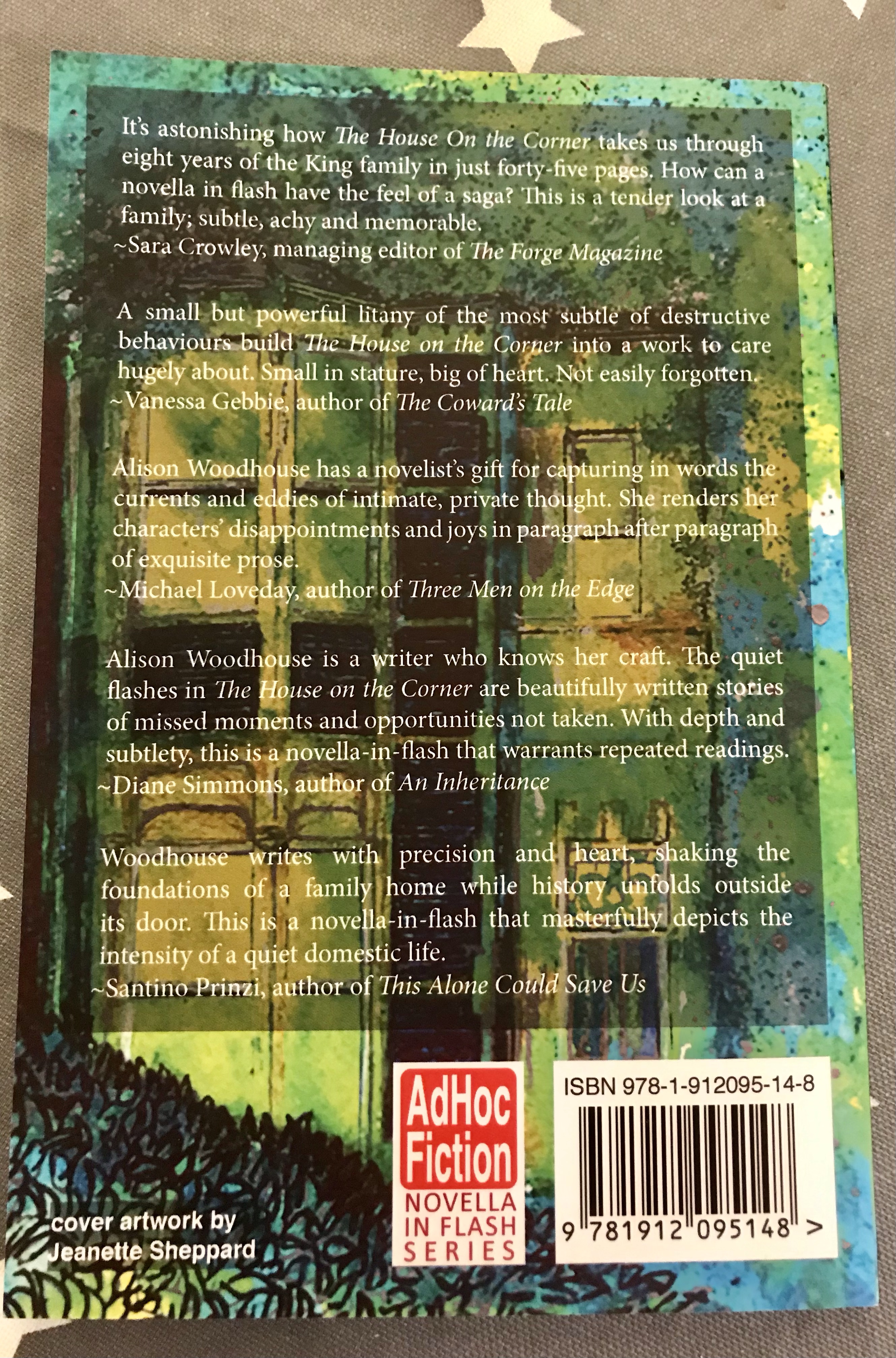
The House On the Corner by Alison Woodhouse

It’s astonishing how The House On the Corner takes us through eight years of the King family in just forty-five pages. How can a novella in flash have the feel of a saga? Each chapter adds layers to our understanding of the Kings. Woodhouse is skilled at taking her deftly drawn characters and revealing the quiet sadness inside them. There’s magic here in what’s unspoken. We recognise these people trying to make life work despite the disappointments. This is a tender look at a family; subtle, achy and memorable.

Signed copies are available from Alison’s website.