A Mother’s Reckoning by Sue Klebold

This isn’t the kind of book I would usually read. I am not someone who thrills to tales of real life violence; the True Crime section in the bookshop is of no interest to me and although I do read in-depth newspaper and magazine articles, I try to steer clear of sensationalist nonsense that seems to glamorise crime. There’s a ton of that crap about though, so clearly there’s an audience.

Sue Klebold is the mother of Dylan Klebold, one of two teens who murdered 13 people at Columbine High School in 1999. Dylan Klebold and Eric Harris injured another 24 people, attempted to kill many more with home made bombs which failed to detonate, and committed suicide. I haven’t read anything beyond news reports at that time, did not want to read assumptions and theories about what happened, but was interested to hear that Sue Klebold had written a book and curious to know what she had to say. I imagined it would be a painful read, and I approached it with empathy – I am a mother of teens, I know our teens make choices that aren’t comfortable for us, but this horror is unimaginable and unbearable. There are those who squarely blame the parents  – how could they not have seen who their sons were? That’s not how I think, but how do you live with that anger against you, that level of blame? How do you endure when your son is revealed to be a hate filled murderer?

This book is Sue Klebold’s attempt to do something positive. She wants to alert people to the signs she missed in her own son (that he had “brain illness”, that he was depressed, bullied, at break point. She aligns herself with other mothers of kids who committed suicide, albeit murder-suicide, and speaks about how her son wanted to die. Unlike Eric Harris, who wanted to kill. There is a clear distinction.)

Sometimes people speak passionately and the words are vivid and maybe a little messy, but heartfelt, and other times, usually when professionals speak, each word has been carefully chosen and the delivery is dry and careful. This book is the latter. It reads as if lawyers have combed through it 1,000 times for anything potentially damaging. There is nothing here but a few descriptions of her son, meaningless to anyone except her family, a few anecdotes that present him as “normal”, a lot of scientific evidence of brain illness, and an avoidance of anything potentially controversial. The first few chapters describe her disbelief as the police turn up at her home immediately after the shootings. She has no access to news but bits filter through as she waits outside while the house is searched, enough that she understands her son was involved. She assumes he was an unwilling participant, or didn’t understand what was happening, or was in thrall to Eric Harris. But she won’t describe the actual events, or what it felt like to comprehend the truth.

There is a necessary need not to offer a template for others, but what is left is not a compelling read. It’s a terrible story, but we do not learn anything here and Klebold seems reluctant to go beaneath the surface. Perhaps she can’t, our minds protect us from unbearable things, but it makes me wonder why she wrote this.

The most valuable thing in the book is not written by her. In the introduction, Andrew Solomon says, “…we want to believe that parents create criminals because in supposing that, we reassure ourselves that in our own house, where we are not doing such wrong things, we do not risk this calamity. I am aware of this delusion, because it was mine…

I came away thinking that the psychopathy behind the Columbine massacre could emerge in anyone’s household. It would be impossible to predict or recognise; like a tsunami, it would make a mockery of all our preparations.”

Which is chilling, but feels true to me. There is a tipping point when our children, necessarily so, grow away from us and all we can do is hope the foundations we have laid hold them steady. We can’t be responsible for their actions. Klebold’s efforts to get more recognition and support for people suffering mental illness is admirable and I applaud her determination to use this awful notoriety she has to do something positive. I don’t think this is a good book though. There are a variety of assertions made – “We’ve all felt angry enough to fantasise about killing someone else.” Well, no, actually I haven’t. “Most of us can’t name a single celebrity who has struggled–successfully anyway–with depression or another mood disorder…” Erm, well actually I can… There’s an attempt to present Dylan Klebold as a “normal” teen but offers scant evidence of it and all the while we know that behind his mother’s back he was writing diaries planning his suicide, filming vitriolic segments with Eric Harris, playing with guns, getting into trouble with the police.

Why would we want to judge Sue Klebold? Why would we need to? I hope she finds a peace in her activism and support. But this is a book review and this book is not great.

Smash Lits with Brian Broome

I had the absolute pleasure of choosing a brilliant non-fiction flash to publish this week at The Forge Literary Magazine. Balk by Brian Broome manages to be poignant, achy, sad and funny. It’s a snapshot of him as a young, gay, black American boy and it fucking rocks. As does his Smash Lits interview. Thanks, Brian!

1) What is your favourite cheese?

Whiz.

2) What was your favourite book as a child?

“The Pigman” by Paul Zindel.

3) Who is/was your unlikely crush?

Alan Alda.

4) Who would play you in the film of your flash?

Caleb McGlaughlin from “Stranger Things”.
(Aww – I can see that!)

5) Bacon VS Tofu – who wins? Why?

IMG_4947

Bacon, Bacon, Bacon, Bacon. Why? Because bacon and I read that tofu gives men boobs. I don’t care if that’s true or not and I guess enough bacon could give me boobs. But, if I’m gonna have boobs, they’re gonna be bacon boobs.

6) Creative nonfiction or fiction? Why? 

Creative nonfiction to write. Fiction to read.

7) Your writing is music, what style is it?

Any of the unfinished symphonies or K-POP.

8) Have you ever had a nickname? What?

Never ever tell. Ok, my Dad called me Big Boo.

9) Do you believe human beings can spontaneously combust

Yes. I’ve seen it.

10) How much money did you spend yesterday?

I spent 52 dollars at the Dollar Store.

11) What’s your most vivid childhood memory?

I think you may have just read it.

12) Do you bite your nails?

Yes. But, only for grooming purposes, not out of nervousness.

13) What’s your favourite sweet (candy)?

OREOS!! ALL THE 500 FLAVORS.

14) What is your motto for life?

Construct. Delude. Believe.

15) What did you do last Saturday night?

I worked. I wait tables and Saturday is a big night.

16) You hold a dinner party and can only invite writers. Who do you
invite?

Jackie Collins and Frantz Fanon. THAT would be interesting.

17) Do you have any writing rituals?

Procrastinate until the last minute.

18) What’s your favourite ball?

Any of the balls featured in “Paris is Burning”.

19) What’s your favourite swear?

GATDAMN!!

20) What question should I have asked you?

“Do you enjoy your life?”
Answer: “I guess so.”


Ghost trees

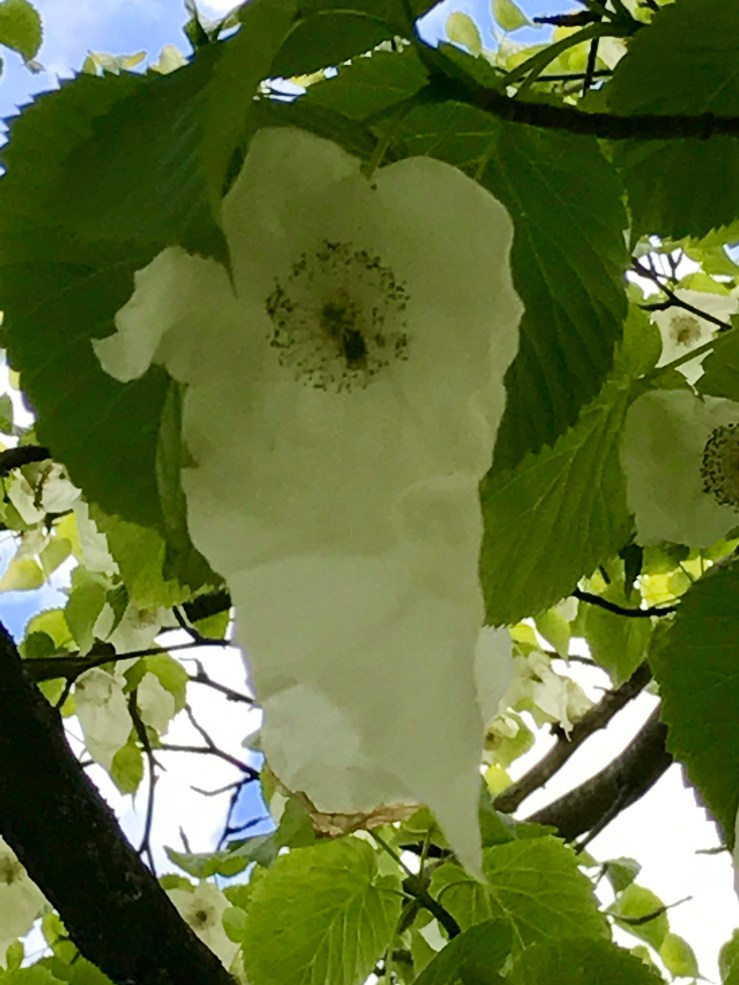
I visited the University of Oxford Botanic Gardens on Friday. This wonderful tree, a Davidia involucrata – informally known as a handkerchief tree, a dove tree, or a ghost tree, because of its beautiful white “bracts” which flutter in the breeze – is in full bloom, and truly a glorious sight.

fullsizeoutput_159dfullsizeoutput_1597

Last night, when I couldn’t sleep, I kept thinking about it. What a tree! How brilliant that I didn’t know it existed and then there it was; perfect, astonishing, surprising.

It’s nine years today since Matt Kinnison died. I bet he’d have liked this tree. He’d probably have known all about it because he knew a LOT of things. He’d have liked the informal names and the floaty shapes and the fact it’s named after Father Amand David, a French missionary who lived in China and discovered the Giant Panda.

Nine years passing means the sting, the grief, the pain, has gone. Not having Matt in my life is the norm now. Such a bloody shame though.

Tastes Like Fear by Sarah Hilary

Sarah Hilary’s London is full of shadows, darkness, underground places where people can vanish; places full of people, estates, tower blocks, all with blind spots and corners around which people disappear. A young girl running away from something, or someone, causes a car crash. Another girl is missing. Around a table, three well behaved young girls eat dinner served by a slightly older girl, presided over by a man. His name is Harm. On an estate an elderly woman watches warily from her window, noting names and times of the kids outside running riot. What links these people?

This is the third DI Marnie Rome book and if you are a fan of the others in the series you won’t be disappointed. Hilary’s customary intelligence and storytelling verve are in full force. It’s amazing how chilling words on a page can be. There’s a smashing twist that I genuinely didn’t see coming, oh, and tantalising snippets woven in about Stephen Keele, the killer of Rome’s parents, whose story we MUST learn one day.

I can’t say more for fear of spoilers, so I’ll leave you with this:

“The kitchen reeked of wax. Fourteen candles burning but they didn’t make it brighter, just dragged in more of the darkness. Greedily, the way his pain pulled at her, at everything.”

The Museum of You by Carys Bray

9780091959609

When Carys Bray writes, woah, she sure does get you in the feels. Both “The Museum of You” and Bray’s first novel, “A Song for Issy Bradley,” deal with the aftermath of death, but Bray has a wonderful way of illuminating darkness with humour and empathy so the novels remain a pleasure to read.

Clover Quinn’s mother Becky died six weeks after Clover was (unexpectedly) born. Now 12, Clover lives with her bus driver dad, Darren, whose silence on the subject of her mum only fuels her desire to know more. In the long summer holidays, inspired by a school trip to the Merseyside Maritime Museum, Clover attempts to curate an exhibition of her mum, using bits and bobs of belongings that have remained in a cluttered, untouched bedroom for years. Where the novel is strongest is in the relationship between Clover and her dad and in the depiction of him adapting to a life that looks entirely different from how he’d once hoped. Darren is a wonderfully sympathetic character, flawed as all of us are, and very recognisable in his attempts to be the best parent he can.

“He could make jam or something. He remembers the things mum used to make with the raspberries: cheesecakes, trifles, tarts, fools and mousses. They could have a go, him and Clover, she’d like that. He has had these ideas before but it’s a struggle to make them materialise; by the time he gets home there will be something else to occupy his thoughts – the detached radiator, the hall walls, the worry that there may be something else she needs.”

The novel features a supporting cast of characters, the most interesting of whom is Jim, Darren’s troubled brother in law who has mental health issues and is hopeless at self-care. Describing Darren’s feelings towards him – “His kindness comes in bursts and he tires quickly. It was easier in the early days, when it seemed as if it was going to be more of a sprint than a marathon,” succinctly describing the fluctuating resolve of trying to help someone desperately needy who doesn’t seem likely to want to, or be able to, ever change.

Mrs Mackeral is the malapropism yelling next door neighbour who is maybe a little too cartoonish to feel fully realised, but provides some amusing moments. Colin is Darren’s best mate who along with his sister, and Darren’s dad, form a kind of family unit around Clover. Whilst death underpins the narrative, there is a sense of optimism that this wonky group provide.

Clover is deftly drawn and is a character to cheer for. The story is heart warming whilst not shying away from truth.

Towards the end of the book Bray writes,“Grief never goes away. And that’s no bad thing – it’s only the other side of love, after all.”
How beautiful is that?

This is an emotionally honest novel written by a writer who marries real insight with engaging writing.

There’s nothing more boring than other people’s dreams…

I dreamt about my dad. I was in a large block of offices full of people and saw him at the top of some stairs. He was wearing a suit, shirt and tie. He looked more 70’s dad than anything (maybe my subconscious translating the priests’ assertion that dad would have a “new and glorified body” and assuming pre heart attacks would be a prime point in time.)

I said “I really miss you.”
And he said “I really miss you too.”
And we hugged.
He said, “You’ll be coming to the thing tonight though? I’ll see you again there.”
And I said, “Yes.”

Then, in my dream, I thought, I mustn’t forget this. Remember.
I went up to dad and I said “I really miss you.”
And he said “I really miss you too.”
And we hugged.
He said, “You’ll be coming to the thing tonight though? I’ll see you again there.”
And I said, “Yes.”

But I didn’t know what the thing was. I didn’t know how to get there. I retraced the conversation over and over, looking for clues.

I went up to dad and I said “I really miss you.”
And he said “I really miss you too.”
And we hugged.
He said, “You’ll be coming to the thing tonight though? I’ll see you again there.”
And I said, “Yes.”

I went up to dad and I said “I really miss you.”
And he said “I really miss you too.”
And we hugged.
He said, “You’ll be coming to the thing tonight though? I’ll see you again there.”
And I said, “Yes.”

I went up to dad and I said “I really miss you.”
And he said “I really miss you too.”
And we hugged.
He said, “You’ll be coming to the thing tonight though? I’ll see you again there.”
And I said, “Yes.”

And this looped on for who knows how long. And when I woke up I thought I mustn’t forget this.
I went up to dad and I said “I really miss you.”
And he said “I really miss you too.”
And we hugged.
He said, “You’ll be coming to the thing tonight though? I’ll see you again there.”
And I said, “Yes.”

I really miss my dad.

The grief underpins everything. Sometimes it feels dormant, but just when I think it is safer now, less spiky, it washes over me like an unnoticed wave that I have my back to, plunges me right back into salt and panic.

Last week I spent time with two gorgeous women who reminded me of who I am. This is what friendships should be like; time spent with people who don’t judge, who don’t monologue at me, who don’t insist everything has to be funfunfun, who understand that life is complex, who don’t leave me exhausted and drained, who don’t put me down, but instead lift me. I am so grateful to know these smart, thoughtful, ace people. Thank you KG and KM!

(Photo taken from Worthing pier yesterday. A beautiful day with Si. Calm waves, blue sky, love.)


It’s difficult…

My first online blogging was done via LiveJournal way back whenever. I had a small group of readers whose LJ’s I also read. We commented on each other’s posts and it all felt cosy and fun. I was a little wary about being discovered so I used a pseudonym and fake names for all the folk I wrote about, but otherwise it was truth all the way. Then I set up “A Salted”, a blog in which I discussed working in a big bookshop and writing and reading. It was less gossipy than LJ, but still it was definitely a personal blog. Then came this one. I have way more publications to my name and I wanted to feature them and promote my writing. I also review books. Sometimes I interview other writers, beginning the Smash Lits interviews because I get so incredibly bored by all the writer blog tours. I prefer to read blogs that make me feel I am reading about a person. I hate twitter accounts that are repeated links to someone’s writing and RT’s of praise and fake reviews. (Five *****’s to Sara Crowley’s extraordinary story!) Facebook pages full of dry self promotion. Blogs that drone on. Who cares?

I have become so cautious about what I say, I don’t tell the truth about my life to anyone really. I am fake and polite and careful at all times. What would happen if I told the truth? Oh my goodness, people might know how I feel and what’s going on, and then what? How…exposing.

We live at a time when I can watch “Reality” TV shows in which young people will have sex, get drunk, show their entire bodies, but never reveal themselves. It’s a curious honesty. Big Brother contestants sleep together unabashed, yet refuse to discuss whether or not they might date as if suggesting they might want a relationship opens them up to a potential embarrassment far greater than showing their genitalia to the cameras. It feels as if having sex with someone is fine, but wanting the hand-holding, chatty bit of a partnership is too much.

Random thoughts:

It’s six months since dad died and it very much feels like my life has divided into before he died and after. After has been miserable as hell. I look at pictures or think of things and go, ah, yeah, that was before dad died. That was before I lost the weird innocence I didn’t know I had.

My new job is great. It’s the one bright spot in an otherwise terrible year.

There are so many things I don’t talk about. I keep secrets and lock away so much sadness that I may explode.

People say you find out who your friends are in times of crisis. What if you find out you don’t have any?

At my dad’s funeral the church was full. He was such a friendly, popular guy many people wanted to pay their respects. I don’t know who would come to mine; not so many, that’s for sure. I went to a neighbour’s funeral last week. Her husband died 25 years ago and they didn’t have children. After all her struggles, her endurance, her keeping on with a smile and joke, life ended. That’s what it does. She was 96 and she had told me all her friends were dead, even the younger ones.

We get through our lives however we do, and it ends. That’s a certainty. I will die. You will die. Everyone we love will die. And in the meantime I’m alive, I’m sad, I’m pissed off, I’m increasingly afraid my life will end before I have written my fucking novel, I’m fat, flawed, exasperated, but I do my best to put some good out into the world, to be a decent person, to keep on keeping on even though the ground has turned out not to be solid and it all feels so bloody hard.

My most used saying of 2016 so far is, “It’s difficult…”

My name is Lucy Barton by Elizabeth Strout

Strout is an exemplary storyteller and having adored Olive Kitteridge so damn much, I trust her to tell a quietly unfussy and moving story. MNiLB is narrated by Lucy Barton who looks back at a long stay she had some time in the eighties in hospital recovering from a post-op infection. Her husband and children were largely absent while she recuperated, and her mother, who she hadn’t seen for many years, flew, for the first time, from her small rural home in Amgash to New York. Remaining by her bedside for several days and nights, her mother offers up anecdotes as conversation; tidbits of other’s lives, gossip about neighbours Lucy might recall. Morality tales in the main. Fragments are revealed, as they are in our actual memories, this happened, and this, do you remember? And the pieces of the puzzle are laid out until, oh, yes, we see the picture now. Lucy’s childhood, one of emotional deprivation as well as physical, is revealed. The agonies of not being a fit remaining throughout her life no matter how she learned to blend in with the help of money, husband, kids, a writing career, a New York life.

“Loneliness was the first flavour I tasted…”

Lucy finds a voice through writing, but can’t express herself to her mother. Theirs are conversations where what is not said matters more than what is. We learn obliquely about her father’s PTS and subsequent cruelty, the humiliation he heaped upon her brother, Lucy’s marital problems and her friendship with a neighbour who dies of AIDS.

“It turned out I wanted something else. I wanted my mother to ask about my life. I wanted to tell her about the life I was living now. Stupidly — it was just stupidity — I blurted out, ‘Mom, I got two stories published.’ She looked at me quickly and quizzically, as if I had said I had grown extra toes, then she looked out the window and said nothing. ‘Just dumb ones,’ I said, ‘in tiny magazines.’ Still she said nothing.”

The hopefulness that she can share and connect is calmly devastating.

Glowing at the centre is her relationship with author/teacher, Sarah, who instructs Lucy to write the pages we have read. “This is a story about a mother who loves her daughter,” Sarah says about the writing Lucy has shown her. “Imperfectly. Because we all love imperfectly. But if you find yourself protecting anyone as you write this piece, remember this: You are not doing it right.”

This slim novel’s layers peel back to reveal the lumpy truths of a life and its relationships and lays them out for us to examine and recognise. Superb.

The Way We Die Now by Seamus O’Mahony


My dad died on February 15th and my world transformed. I am grief-stricken. It’s no surprise that I have turned to books seeking solace, or at least some kind of understanding. The first book I read was “When Breath Becomes Air” which in retrospect I found unsatisfactory and unhelpful. “The Way We Die Now” though has been a strangely compelling read despite its rather stark message. Right from the introduction O’Mahony warns us, “This is not a book of consolation; death is simply affliction and the end of our days. We are frail and vulnerable animals.”

He argues persuasively and passionately against the over medicalisation of death. As a Consultant Gastroenterologist at Cork University Hospital Dr O’Mahony has seen many people die and he uses a mixture of personal anecdotes, patient anecdotes, and high profile celebrity deaths, to highlight how our society places faith in medicine and expects to live despite disease. He explains how many patients receive what he believes to be useless treatments; procedures that take place for the sake of the hospital being seen to do something, often at the expense of a patient’s comfort. CPR that takes place after death is common apparently (and he is clear that CPR is rarely successful as it is in medical dramas. It’s a brutal technique that can leave people permanently damaged if they do survive.) Speaking about the overuse of PEG feeding he says “The procedure became for me a symbol of the medicalisation of death, and of the failure of modern medicine to care humanely for those most in need of its help.”

He is wonderfully dismissive of Kugler-Ross’s famous five stages; denial, anger, bargaining, depression and acceptance. “The power and terror of death refuses to be tamed by workshops, by trite formulae.” The myth of a “good death” is exploded. It is likely we will die whilst sedated and pain-free thanks to a syringe driver. We won’t make profound death bed statements, we won’t even speak. We will be removed from our own death, but that saves us from dying in terror and pain. There is rarely a peaceful, stoic acceptance. That word terror catches me and makes me realise I had some fairy story death narrative in my head where gradually people slip away. Here’s my comfort, such as it is, my dad died unexpectedly. His heart stopped. He did not know he was dying. We did not have the agonies of having to decide for him what interventions he should endure so that we could keep him with us. I fear I would have insisted on all of them, though I hope I would not have.

O’Mahony writes he was “…deeply impressed by how Catholic ritual – after the deaths of my great-uncle and father in-law – guided the bereaved during the days immediately following their deaths.” The issue in a secular society where “Evangelical atheism has accelerated the flight from religion” is how to find this kind of comfort, and he suggests we worry less about believing and be content with simply belonging. This really chimed with me. Dad had a full Catholic funeral; his body was received into church the night before and his priest led us gently through the rituals and beliefs. During the funeral he took the same care to explain. It felt unimportant I don’t share those beliefs. I was immensely grateful for this acknowledgement of loss and grief, this solemnity, this tribute to my dad.

The book explores “deluded optimism” where patients, doctors, and family and friends collude in a pretence there is hope where there is none. What bloody fools we are that we think we can tame death. There is so much that is interesting here; the fact that patients who have combined oncology/palliative care live on average 25% longer than those who forge on with treatment (seeing hospices as an admission of failure), and that doctors apparently often choose not to undergo extensive treatment themselves. The idea that doctors offer treatment because they don’t know what else to do and need to be seen as doing something is troubling, yet the instinct is to want them to do every possible thing to save the lives of those we love.

How afraid we are, of course, and we are right to be. There’s no magic here, but this is a cool, intelligent look at death, right in its ghastly, deathy face.