My name is Lucy Barton by Elizabeth Strout

Strout is an exemplary storyteller and having adored Olive Kitteridge so damn much, I trust her to tell a quietly unfussy and moving story. MNiLB is narrated by Lucy Barton who looks back at a long stay she had some time in the eighties in hospital recovering from a post-op infection. Her husband and children were largely absent while she recuperated, and her mother, who she hadn’t seen for many years, flew, for the first time, from her small rural home in Amgash to New York. Remaining by her bedside for several days and nights, her mother offers up anecdotes as conversation; tidbits of other’s lives, gossip about neighbours Lucy might recall. Morality tales in the main. Fragments are revealed, as they are in our actual memories, this happened, and this, do you remember? And the pieces of the puzzle are laid out until, oh, yes, we see the picture now. Lucy’s childhood, one of emotional deprivation as well as physical, is revealed. The agonies of not being a fit remaining throughout her life no matter how she learned to blend in with the help of money, husband, kids, a writing career, a New York life.

“Loneliness was the first flavour I tasted…”

Lucy finds a voice through writing, but can’t express herself to her mother. Theirs are conversations where what is not said matters more than what is. We learn obliquely about her father’s PTS and subsequent cruelty, the humiliation he heaped upon her brother, Lucy’s marital problems and her friendship with a neighbour who dies of AIDS.

“It turned out I wanted something else. I wanted my mother to ask about my life. I wanted to tell her about the life I was living now. Stupidly — it was just stupidity — I blurted out, ‘Mom, I got two stories published.’ She looked at me quickly and quizzically, as if I had said I had grown extra toes, then she looked out the window and said nothing. ‘Just dumb ones,’ I said, ‘in tiny magazines.’ Still she said nothing.”

The hopefulness that she can share and connect is calmly devastating.

Glowing at the centre is her relationship with author/teacher, Sarah, who instructs Lucy to write the pages we have read. “This is a story about a mother who loves her daughter,” Sarah says about the writing Lucy has shown her. “Imperfectly. Because we all love imperfectly. But if you find yourself protecting anyone as you write this piece, remember this: You are not doing it right.”

This slim novel’s layers peel back to reveal the lumpy truths of a life and its relationships and lays them out for us to examine and recognise. Superb.

The Way We Die Now by Seamus O’Mahony


My dad died on February 15th and my world transformed. I am grief-stricken. It’s no surprise that I have turned to books seeking solace, or at least some kind of understanding. The first book I read was “When Breath Becomes Air” which in retrospect I found unsatisfactory and unhelpful. “The Way We Die Now” though has been a strangely compelling read despite its rather stark message. Right from the introduction O’Mahony warns us, “This is not a book of consolation; death is simply affliction and the end of our days. We are frail and vulnerable animals.”

He argues persuasively and passionately against the over medicalisation of death. As a Consultant Gastroenterologist at Cork University Hospital Dr O’Mahony has seen many people die and he uses a mixture of personal anecdotes, patient anecdotes, and high profile celebrity deaths, to highlight how our society places faith in medicine and expects to live despite disease. He explains how many patients receive what he believes to be useless treatments; procedures that take place for the sake of the hospital being seen to do something, often at the expense of a patient’s comfort. CPR that takes place after death is common apparently (and he is clear that CPR is rarely successful as it is in medical dramas. It’s a brutal technique that can leave people permanently damaged if they do survive.) Speaking about the overuse of PEG feeding he says “The procedure became for me a symbol of the medicalisation of death, and of the failure of modern medicine to care humanely for those most in need of its help.”

He is wonderfully dismissive of Kugler-Ross’s famous five stages; denial, anger, bargaining, depression and acceptance. “The power and terror of death refuses to be tamed by workshops, by trite formulae.” The myth of a “good death” is exploded. It is likely we will die whilst sedated and pain-free thanks to a syringe driver. We won’t make profound death bed statements, we won’t even speak. We will be removed from our own death, but that saves us from dying in terror and pain. There is rarely a peaceful, stoic acceptance. That word terror catches me and makes me realise I had some fairy story death narrative in my head where gradually people slip away. Here’s my comfort, such as it is, my dad died unexpectedly. His heart stopped. He did not know he was dying. We did not have the agonies of having to decide for him what interventions he should endure so that we could keep him with us. I fear I would have insisted on all of them, though I hope I would not have.

O’Mahony writes he was “…deeply impressed by how Catholic ritual – after the deaths of my great-uncle and father in-law – guided the bereaved during the days immediately following their deaths.” The issue in a secular society where “Evangelical atheism has accelerated the flight from religion” is how to find this kind of comfort, and he suggests we worry less about believing and be content with simply belonging. This really chimed with me. Dad had a full Catholic funeral; his body was received into church the night before and his priest led us gently through the rituals and beliefs. During the funeral he took the same care to explain. It felt unimportant I don’t share those beliefs. I was immensely grateful for this acknowledgement of loss and grief, this solemnity, this tribute to my dad.

The book explores “deluded optimism” where patients, doctors, and family and friends collude in a pretence there is hope where there is none. What bloody fools we are that we think we can tame death. There is so much that is interesting here; the fact that patients who have combined oncology/palliative care live on average 25% longer than those who forge on with treatment (seeing hospices as an admission of failure), and that doctors apparently often choose not to undergo extensive treatment themselves. The idea that doctors offer treatment because they don’t know what else to do and need to be seen as doing something is troubling, yet the instinct is to want them to do every possible thing to save the lives of those we love.

How afraid we are, of course, and we are right to be. There’s no magic here, but this is a cool, intelligent look at death, right in its ghastly, deathy face.

When Breath Becomes Air by Paul Kalanithi

92aac483e96cd907f6b3732cf5654b44

Paul Kalanithi spent years training to be a neurosurgeon. He was one of those dazzling people who could have followed any number of paths, studying literature, philosophy and medicine with equal vigour. He trained in neurological surgery at Stanford University, believing brain surgery was his calling. The ridiculous workload (100 hour work weeks) and literal life and death operations, his striving for compassion and excellence in everything he did, his relationship with his girlfriend, Lucy, also a doctor, are all examined in the first half of this book. Kalanithi’s love of literature shines as brightly as his love of medicine.

When he began to suffer with excruciating back pains he wondered if he had cancer, then tried to push that concern away after an x-ray came back clear. He got weaker and the pain intensified. Eventually he had a CT scan, “I flipped through the CT scan images, the diagnosis obvious: the lungs were matted with innumerable tumors, the spine deformed, a full lobe of the liver obliterated. Cancer, widely disseminated. I was a neurosurgical resident entering my final year of training. Over the last six years, I’d examined scores of such scans, on the off chance that some procedure might benefit the patient. But this scan was different: it was my own.”

Where the first half of the book is concerned with his striving to be the best surgeon he can and to help others deal with unthinkable disease and their fragility as humans, their lives literally in his hands as he operates on their brains, the second half is him looking frankly at his own situation as he makes the transformation from expert doctor to needy patient.

“Once I had been diagnosed with a terminal illness, I began to view the world through two perspectives; I was starting to see death as both doctor an patient. As a doctor, I knew not to to declare “Cancer is a battle I am going to win!” or ask “Why me?” (Answer: Why not me?)”

“Like my own patients, I had to face my mortality and try to understand what made my life worth living…”

It’s his clear thinking that engages the reader so fully. We, and everyone we know, will die. It is the awful truth we spend our days not looking at and here is someone who has studied the brain extensively, who knows what it is to look right at death, someone who writes with zinging clarity, preparing to share his wisdom with us so that we may go forwards in our own lives in a more meaningful way.

“The physician’s duty is not to stave off death or return patients to their old lives, but to take into our arms a patient and family whose lives have disintegrated and work until they can stand back up and face, and make sense of, their own existence.”

Everything Kalanithi had worked so hard to achieve in his future, his ambitions and hopes, were lost with diagnosis. He had to examine what was most important to him. As he wrestled with choosing between literature and medicine before specialising, he wrestled again. He returned to surgery for a while, completing his residency with customary excellence despite everything. Offered his dream job he briefly allowed himself the fantasy of accepting it, before turning it down. He and Lucy decided to have a baby. He wrote most of this book. In the end it all boiled down to the deeply personal, as it does for us all. The things that matter are the relationships we have. It’s family and friends and love that count.

This is why When Breath Becomes Air is successful. We are desperate for clues how to live, how to die, how to cope. It’s unfair to expect so much from a book. Its unfair that Kalanithi died when he was 37. Life, and death, is not fair.

Your Father Sends His Love by Stuart Evers

  
In this collection, Evers deftly explores fatherhood. He’s an unfussy writer whose clear prose allows the stories to unfold smoothly (before sometimes tripping us up and challenging our assumptions) using small details to great effect;

“A silent cabbie aside from his metronomic sniffing.”

and

“Rosemary moved to be with her parents upsatate. Like Russian dolls, a mother retreating to her girlhood bedroom.”

“These Are The Days” is ostensibly about a relationship between a Grandfather and his Granddaughter. Twenty-one year old Anna unexpectedly turns up at her Grandfather’s home. He appears to be a doting, gentle man, but is unmasked as a negligent father and husband before once again becoming a sympathetic character as his son is revealed as a bully. It’s a tricky thing to pull off, but Evers makes character switches flow naturally and these grey areas are gorgeously insightful.

A man sits in a pub, waiting for his bereaved friend to arrive, rehearsing small talk in “Something Else To Say.”  Repetition is used to convey the sheer lack of anything useful one can say when someone’s child has died. All the vital stuff remains unspoken and yet is beautifully conveyed in this touching tale.

I think the title story; “Your Father Sends His Love” is astonishing. It’s definitely the best story I’ve read this year and is an incredibly powerful piece that I don’t want to ruin for anyone else by attempting to describe. I could not stop thinking about it for days after; I was haunted by it and it’s well worth the price of the book alone. As it’s positioned half way through the collection, the stories after perhaps suffer a little in comparison. “Charter year, 1972” seemed strangely clunky; a set up and a punch line.

The last story “Live From the Palladium” has a similar source to “Your Father Sends His Love” and I’m fascinated by how Evers takes this material and shapes it into such achy and perceptive fiction.

If you’re a fan of quietly powerful stories (and who isn’t?) then do give this a read.

An Untamed State by Roxane Gay

Roxane Gay’s short fiction has appeared in many of the literary journals I’ve read over the last eight years or so. She’s editor of the mighty PANK. She writes a wonderful blog. Her non-fiction has appeared in many esteemed publications. She basically rules Twitter with her always interesting observations. She has a very clear, authoritative voice and I have long had a complete writer crush on her. Her collection of essays “Bad Feminist” has just been published in the UK. It’s currently number 13 in the New York Times non-fiction bestseller list. Roxane Gay is really successful now which is amazing and fabulous and so bloody well deserved. 

A collection of her stories – “Ayiti” – was published in 2011 which I reviewed here. Interestingly the passage I quoted from “Things I Know About Fairytales” features in her debut novel “An Untamed State” which continues exploring the chasm in Haiti between the rich and poor and contrasts it with life in the US. 

Mireille Duval James is a young woman from Haiti who lives in America. She is smart and feisty, an attorney married to an American man, Michael. They have a baby son, Christophe. Returning to Port-au-Prince to visit her wealthy, successful parents, Mireille, Michael and Christophe set off for the beach when their car is surrounded by a group of violent criminals who abduct Mireille, demanding a huge ransom. Her father, Sebastien, refuses to pay, believing that negotiating with the kidnappers can only endanger other members of his family.

Once upon a time, in a far-off land, I was kidnapped by a gang of fearless yet terrified young men with so much impossible hope beating inside their bodies it burned their very skin and strengthened their will right through their bones.

     They held me captive for thirteen days.

     They wanted to break me.

     It was not personal.

     I was not broken.

     This is what I tell myself.


What follows is a difficult read. Gay’s powerful prose explores the brutality and violence that is inflicted upon Mireille day after day. I flinched from the words. This is not a book I could look forward to reading. It’s a depiction of a woman being abused in every way imaginable. The first part weaves stories from Mireille and Michael’s relationship with time from her imprisonment. It’s necessary to have the relief the memories of their courtship offer. The second part deals with the aftermath. How does a woman survive such atrocities? Tortured, gang raped, imprisoned, how can Mieille possibly move forwards? 

It’s a novel about family: Mireille’s parents and the compromises her mother makes, her father, her sister, Michael’s parents, their son, Christophe. It’s also about personal endurance, self-preservation, the political implications of poverty, violence, domination, hope and courage.  It’s an impossibly dark read. And very powerful.

When I finished reading I googled to find out more about Port-au-Prince and kidnapping. The UK government issues a warning that they will not negotiate with kidnappers believing, as Mireille’s father does, that it only increases the likelihood of more kidnaps. The BBC warn “No one is safe from kidnapping, regardless of occupation, nationality, race, gender, or age.” 

Horrifying.


All My Puny Sorrows by Miriam Toews

“All My Puny Sorrows” (what an excellent title!) by Miriam Toews is an extraordinary book about two sisters (Elfrieda and Yoli) and their Mennonite family. It’s Yoli’s first person account of how Elf attempts suicide and begs for Yoli’s help to die. What makes it so special is how Toews takes this devastating material and manages to make it consistently witty, genuinely funny, and real. Her own sister committed suicide, as did their father. It’s as if Toews is reporting directly from the frontline of grief. She’s such a talented writer that she’s somehow managed to form this tragic raw material into an incredible novel.

It is full of so many great lines that I highlighted huge chunks of the book. From incidental throwaways such as this:

“I hope she doesn’t have an eating disorder. I’ve read that eating disorders are often the fault of overbearing mothers, but I’m so underbearing it’s not even funny. Maybe she’s imagined an overbearing mother to compensate for my lack of bearing and it’s this imaginary pushy mother that’s caused her to have an eating disorder. She doesn’t have an eating disorder, not really. I shouldn’t try to blame something that doesn’t even exist on an imagined imaginary mother.”

To criticisms of the medical staff on the psychiatric ward for their lack of attention to Elf as she refused to obey their directions:

“Nurses in cardio are far more playful and friendly than they are in psych.
If you have to end up in the hospital, try to focus all your pain in your heart rather than your head.”

Yoli always feels spot on. I imagine she’d be the best wise-cracking stoic friend a gal could have. How she and her mother endure is wonderfully life-affirming. 


This is my book of the year. Yeah, already. I honestly doubt anything else can make me feel this way. From the perfect title, the perfect cover, to the perfect prose it’s all astonishingly good.

Read it! Read it! Read it!


Vulgar Things by Lee Rourke

After losing his job, and getting drunk, Jon Michaels finds out that his Uncle Rey has died and is persuaded to travel to Canvey and sort through Rey’s personal effects. Jon stays in his uncle’s caravan and discovers recordings, a telescope, letters – things that fracture everything he’d assumed about his life.

Vulgar Things is an odyssey firmly rooted in and around Southend. Rourke’s landscape is not the familiarly romanticised sea, but rather the bleak beauty of grey waves and scrubland. I’m from Essex myself and my parents now live on the Garrison in Shoeburyness (which gets a brief mention) – Southend is a place I know well and it was refreshing to read a novel set there. It made me realise how unheard that voice is and how far away from the TOWIE stereotype much of Essex actually is. The real Southend can be pretty brutal, incredibly sweary, seedy, grubby, violent – drunks and sex workers mingle with day trippers, old folk, families and school kids. Rourke captures this well as Jon walks back and forth from Canvey to Southend, the repetition of the journey, the landmarks he passes, building into the readers consciousness so we feel we’re walking alongside him.  Alcohol is central to the novel, as is the crackle of violence. Jon’s obsession with a woman he briefly meets is part of a deeper story – his character seemingly doomed to repeat a narrative originally played out by his uncle. The woman is wanted not for who she is but for who he imagines her to be. Even the wide Canvey sky bright with stars and planets transforms from reassuring to dizzying, disconcerting, worrying.

The whole novel has a claustrophobic feel despite the sea and skyscapes. The contained life Uncle Rey led in his tiny caravan bleeds into the present day. Jon visits the local pub “The Lobster Smack”, goes on walks with his trusty stick, obsesses over Laura, watches tapes of his Uncle reading from his novel, recorded in the same caravan, over and over. It feels airless and yet the story itself is compelling and I read on, eagerly trying to fit pieces of a puzzle together.

It’s deeply frustrating to feel my mind battle its own limitations. I knew there were layers to the story that I was missing, intentions that went whoosh over my head. Anyway, there’s a brilliantly illuminating interview over at The Quietus that anyone who is interested should go and read. Smarter folk than me etcetera. (Ah, right, Petrarch & Laura!)

Do come back tomorrow if you are interested in knowing what superhero power Lee Rourke would have and what colour he thinks Tuesdays are (Always asking the tough questions). #SmashLits


Into the Trees by Robert Williams

Into The Trees by Robert Williams

When their apparently healthy baby won’t stop crying and they have exhausted all the usual solutions, sleep deprived parents Thomas and Ann become desperate. By chance, Thomas discovers that if he takes Harriet into Bleasdale forest she calms. Raymond, a giant of a man who works as a farm hand, walks the forest at night, glad to escape his damp smothered home in Etherton. Keith goes to the forest for entirely different reasons. From each of their perspectives Williams shows how their lives become entangled.

I worried at the start that there’d be some mystical forces at play, but thankfully no, this is a very real story, shot through with William’s customary insight into the human condition. Unexpected strands are brought in and woven seamlessly into the narrative. Williams does a grand job describing Ann’s first love and the passion that’s missing from her marriage. It was Raymond and his awkwardness who captured my heart though. I know a Raymond or two, and the author’s understanding of what it is to be an outsider, what it’s like to feel so alien in the world, is quite special.

It’s a terrific exploration of fear in many of its guises. There’s no fussy writing here, just clean, clear prose. Williams’s best novel yet.


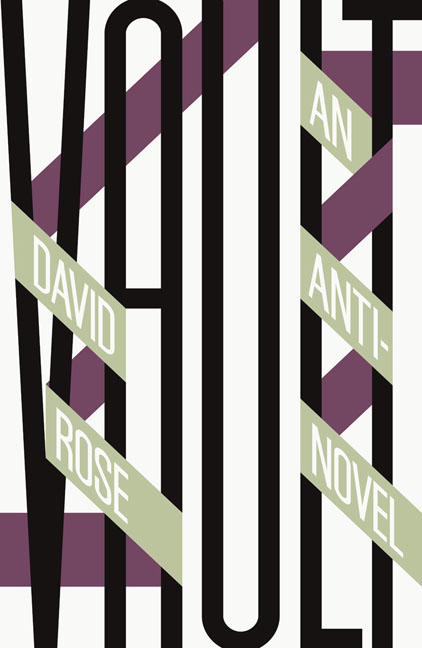
Vault by David Rose

Vault is a compact novel comprising brief chapters marked A or B. The A chapters pertain to a fictionalised version of the narrator of the B chapters. The B chapters are “factual” rebuttals of the novel. No wonder Vault’s subtitle is “An anti-novel”. It sounds complex, but the divisions are smartly done. B is written mainly in clear, clipped prose, whereas A employs (slightly) more flourishes of language.

A cyclist becomes a wartime sniper and afterwards something of a vigilante, and then an unofficial spy. He also falls in love and cycles competitively. That’s a pretty huge range to cover, but there is no padding, no filler in Rose’s writing and the novel is 158 pages.

His character is a loner whose aloofness serves to distance him from those around him, and his readers. Even when describing the love of his life he blankly states: “But this was all a long time ago and, later, she left me.” Nonetheless, the impact of some scenes, I’m thinking of the sniper waiting patiently to kill, and later, after the war, protecting a woman who has received food from an aid station, is heightened by the tightly controlled descriptions.

The cycling sections are beautifully exhilarating and offer welcome relief.

And how wonderful is that cover!

Vault


Rose is clearly a fine writer and I’m looking forward to reading his short story collection – Posthumous Stories, which I’ve just treated myself to.
 

Someone Else’s Skin by Sarah Hilary

Sarah Hilary’s Someone Else’s Skin is published on the 27th of this month (by Headline) and it’s a stonkingly good read. I don’t usually read crime fiction, but I do enjoy watching TV detective shows, as does Sarah. (I know this because we have tweeted each other about our love of “Cho time” in The Mentalist, and our admiration for Luther.) Reading S.E.S I was immediately struck by how much like a television drama the novel seemed. I could “see” the story unfold. It has to be made into a TV show, surely?

Marnie Rome and her partner, DS Noah Jake, visit a women’s refuge in the hope of getting one of the women to testify against her brothers. Whilst there, a man is stabbed by his wife in front of several of the residents. As the officers investigate the stabbing, three of the women go missing.

At the same time, Marnie Rome’s backstory is woven in – her parent’s were murdered five years ago, and Rome regularly visits their murderer.

What follows is an intriguing tale where Hilary continually confounds expectations. Rome is allowed weakness, she makes mistakes, gets angry, and has complex emotions. Her relationships with Noah, and victim support worker, Ed Belloc, are well drawn. It’s a novel where nothing is quite as it seems. Hilary is unafraid of exploring darkness and some big issues, but never at the expense of story. It’s all very page-turny, even if I did find some of the violence unpalatable. It’s a well written, pacey, engaging novel, and I really want to know more about Marnie et al and am looking forward to book two. In the meantime, I had a few questions for Sarah which she agreed to answer for me:

Q. You’re an excellent short story writer, how difficult was it to expand into writing novels? Any words of advice for writers hoping to transition from short story writing to novel writing?

A. Thank you, that’s very kind. I enjoy writing short stories but boy, do I find them hard to get right. I think I’m better suited to writing novels; my stories seem to bend towards the shape of a novel more easily. So, in terms of advice, I’d say go with the shape of the story and see where it takes you.

Q. Where did you write? Any routine/ritual etc?

A. I’m very guilty about the fact that I bought a lovely writing desk when I moved house, and haven’t sat there once. I write in cafes. I like the white noise, and the coffee. I make sure I write for at least two hours before I allow myself a break. It’s the only way I can be sure to get it done.

Q. When you started writing did you know you were creating a series?

A. Always. It’s such a gift to be able to spend time with the same characters.

Q. How far ahead have you plotted in terms of story arc?

A. I try to have ideas for the next book along, whenever I’m writing something new. Not plotting, as such, but nuggets.

Q. Have you written book 2 yet?

A. First draft, yes. I’m about to embark on the second draft so wish me luck.

Q. Would you like to see it made into a TV series? And if so, any idea on who would make a good Marnie Rome?

A. That would be amazing, wouldn’t it? A friend suggested Karen Gillan for Marnie, but I’m not sure. I do know that I’d love Ashley Walters to play Noah Jake.

Q. What is your fave tv detective series?

A. Currently? The Bridge. I love Saga and Martin so much it hurts.

Q. Who is your fave tv detective?

A. Saga Norén.

Q. What about crime novels – any favourites?

A. Everything ever written by Fred Vargas. Also, The Collector by John Fowles, and Silence of the Lambs by Thomas Harris.

Q. You write about domestic violence & female genital mutilation – was it always your intention to try to highlight these issues?

A. No. I started out to write a book about secrets, and deceit. The characters I created each had different secrets, and some of those secrets were very dark. But I do want to talk about issues which have been side-lined by society, especially the ones that make us uncomfortable. There’s too much silence born of discomfort, I think. I’d like to make a bit of noise around those issues, because they matter so much.

Q. Did you do much research?

A. Enough to be sure of my facts, but not so much that it strays into non-fiction or gets in the way of the storytelling.

Q. The book is pretty harrowing with some deeply unpleasant violence. How easy was it to switch off and go and cook tea etc?

A. I don’t cook, which helps..! Writing Someone Else’s Skin did stir up a lot of unsettling emotions in me, but I think that’s part of being a writer, isn’t it? Keeping faith with the dark and the light… The chip of ice in our souls, as Graham Greene called it. I’m not very good at switching off; the next story is always percolating in my head. Probably very unhealthy although my editor would approve.

Thank you Sarah. I wish you and Marnie much success.

If you can’t wait to get your hands on Someone Else’s Skin you can preorder here. I’m sure all fans of crime fiction will be delighted to discover such an intriguing new detective.