Failure

I entered the Mslexia short story competition this year. My favourite writer, Janice Galloway, was the judge, so it was a must. It’s an excellent competition in an excellent magazine. I sent what I consider finished, polished, strong work, and got nowhere. Ah well, that’s the way it goes. I put a flippant post up about it on Facebook, and was heartened by the responses I got, both on the post and in private messages. Many writer friends entered this competition and didn’t make it either. Amongst them are a couple of poets who have collections published, short story authors, again with published collections, and a few published novelists. Professional writers with awesome CV’s entered and failed. That they shared this with me was enormously helpful so I thought I’d share it here in the hope it helps someone else too. I know the quality of these women’s writing. They are damn good. So, let’s remember that another judge may have picked a different final six. What resonates with me may not with you. It’s easy enough to weed out bad writing, but when you have, say, thirty stories all containing good quality writing, it will be about what speaks to the individual reader. If I read the stories belonging to the writers I spoke with on facebook I’m fairly sure I would favour one over the others despite knowing they are all fine writers.

A writer who has judged several competitions told me she only ever sees the entries the first readers have decided should make up the long-list. Who knows, Galloway may have adored my words if she’d ever got to read them, but my genius went unrecognised in the initial sifting process. (Yeah, ok, unlikely, but hey, it’s my thought, I can have it if I want.)

I’ve won competitions before, and I’ve obviously lost them too. Winning is a delightful, validating, endorsement. Losing is a huge blow. It makes you question your worth as a writer. One of the things that was discussed on my Facebook page was that some of the writers had gone back over their entries and were truly surprised to not be able to see obvious edits they could make. I do a great line in self hatred, and the first thought on losing is usually that the story isn’t good enough, and that one was delusional in thinking it might have stood a chance. That’s nonsense, the same story that flops in one place can, and does, succeed elsewhere. That’s not to say improvements can’t be made. Do re-read with a critical eye – change what leaps out, then look for somewhere fabulous to submit to. Keep going. Remember why you write in the first place. I don’t write in the hope of winning competitions, I write because I have this impulse to fictionalise things. It’s part of my being. If I can then share those words and communicate with people, then all the better. If I can get recognition for it, well, better still. Financial recompense would be amazing. I’d love to win ALL the competitions and be published everywhere, but even if I never win anything again, I’m going to keep on writing. Don’t lose sight of the heart of your words. Oh, and to the person who told me (kindly) it might be off-putting to potential publishers to mention failures, I don’t believe that is true.

In his superb book “The Antidote” Oliver Burkeman has this to say about failure:

Fortunately, developing a healthier approach to failure may be easier than you’d think. The work of the Stanford University psychologist Carol Dweck suggests that our experiences of failure are influenced overwhelmingly by the beliefs we hold about the nature of talent and ability – and that we can, perhaps quite straightforwardly, nudge ourselves towards a better outlook. Each of us can be placed somewhere on a continuum, Dweck argues, depending on our “implicit view” – or unspoken attitude – about what talent is and where it comes from. Those with a “fixed theory” assume that ability is innate; those with an “incremental theory” believe that it evolves through challenge and hard work. If you’re the kind of person who strives mightily to avoid the experience of failure, it’s likely that you reside near the “fixed” end of Dweck’s continuum. Fixed-theory people approach challenges as occasions on which they are called upon to demonstrate their innate abilities, and so they find failure especially horrifying: to them, it’s a sign that they tried to show how good they are, but didn’t measure up. The classic example is the young sports star encouraged to think of himself as a “natural” – but who then fails to put in sufficient practice to realise his potential. If talent is innate, his unspoken reasoning goes, then why bother?
Incremental-theory people are different. Because they think of abilities as emerging through tackling challenges, the experience of failure has a completely different meaning for them: it’s evidence that they are stretching themselves to their current limits. If they weren’t, they wouldn’t fail. The relevant analogy here is with weight training: muscles grow by being pushed to the limits of their current capacity, where fibres tear and reheal. Among weightlifters, “training to failure” isn’t an admission of defeat – it’s a strategy.
Happily, Dweck’s studies indicate that we are not saddled for life with one mindset rather than another. Some people manage to alter their outlook simply by being introduced to the fixed versus incremental distinction. Alternatively, it’s worth trying to recall it next time failure strikes: next time you flunk an exam, or mishandle a social situation, consider that it’s happening only because you’re pushing at the limits of your present abilities.

You can read a little more here.  I’m hoping to learn how to see failure as an essential part of life, and stop being so afraid of it – I’m definitely more of a fixed theory person and am hoping to persuade my mind to allow me to become more of an incremental kinda gal.

Matt

It’s hard to believe that there have been five years without Matt. I’m lucky, he’s still in my heart, and my head, I can read his words and listen to his music, I can still conjure him, but damn, he’s missed. This is track 7 from his album Evenings of Ordinary Sand – 15 Yayli Tanbur Taksimleri, and it’d be good if you took the time to listen (if you feel like it). Matt played the Yayli Tanbur beautifully. Not only was he the best bass player I’ve ever heard, he also adored more unusual instruments too, the oddest being the trumpet marine. The illustrations are his too.

Julian Barnes – Levels of Life


Divided into sections entitled The Sin of Height, On the Level and The Loss of Depth, this is Barnes on death. I was going to write “having lost his wife to cancer” but know now how much he would hate that woolly sounding phrase, so – Barne’s wife Pat Kavanagh died four years ago after being with him for thirty years, and this book is an exploration of loss.

I’m not even going to attempt to write a review, I’m just going to say that Barnes is a superb writer, and this stunning book should be read by everyone. Here in clear, precise prose is the truth of the griefstruck. Essential.


The Antidote by Oliver Burkeman


I don’t read self-help books although I have done in the past, when I was young and far less cynical. I loathe positive thinking. I think it’s at best delusional, and at worst severely damaging. The early part of this year was pretty fucking tough for me. An endurance. At work one day I picked up the Burkeman book, intrigued by the subtitle “Happiness for people who can’t stand positive thinking”, and had a flick through. It looked actually useful, and I surprised myself by buying it. To be honest, initially I was most struck by the notion of stoicism and the acceptance of negativity. It fitted with where I was in life, and I took some comfort from what I read. I tried to use it to help me get through each day. As the situation around me improved and I was able to start thinking about getting back to writing, the parts about failure chimed loudly with me. I hope to be able to utilise some of the things I’ve learnt very soon.

Those of you who know me will be aware I usually wear a skull in some form – jewellery or clothing or a scarf etcetera. My love of skulls began when working at The Museum of Mankind. There was an amazing Mexican Day of the Dead exhibition which I adored. The acceptance of death seems the most sensible thing we can do in order to appreciate life, yet it’s hard to find the balance between awareness and fear. So often we blank it out as much as possible so as not to frighten ourselves senseless. I wear skulls to remind myself I am mortal, and also, because they are so darn cute. Burkeman has an excellent chapter on death. 


I feel like I need to refer back to The Antidote – as I read I highlighted pertinent sections and found I’d nearly highlighted the entire book. It’s a guidebook to life, and I highly recommend it.


Fiction trio

These are three of the books I have read recently.

“Infinite Sky” is a YA treat.  One hot summer Iris‘s mother leaves Iris, her dad, and brother, and shortly afterwards a group of travellers set up camp in the family’s field, much to her father’s annoyance. What makes this novel stand out is how Flood depicts the ennui, struggles, and hopes of youth so brilliantly in this tale of star crossed lovers. 


The Night Rainbow is another sun-drenched story. Set in rural France and narrated by five year old Pea the novel manages to be charming despite its dark shadow of death. Pea plays outside with her little sister so not to bother their sad Maman. And Maman doesn’t know that Claude, a man viewed with suspicion by the other villagers, is paying very close attention. A perfect Book Club read, King captures the innocence and wonder of childhood beautifully.

Spellbound proves “Lad Lit” doesn’t have to be shallow – this is a bright and engaging collection of short stories that have real depth. Willans respects women, and that comes through strongly. (I imagine he has plenty of female friends.) These “stories of women’s magic over men” combine pathos, wit, and humour, with a sprinkle of romance, love, and cynicism. 


Instructions For A Heatwave by Maggie O’Farrell

Instructions For A Heatwave by Maggie O’Farrell has just been published by Tinder Press and is simply wonderful. As I read I had that delicious feeling of sinking into the novel, trusting the story to unfold beautifully, knowing I was in the hands of an expert. The huge difference between short stories and novels is how one can relax with a novel and savour it over a period of time. It becomes something to look forward to in a day, a treat, whereas a short story has to be read in one go – there’s an urgency to it, an immediacy.


Set in July 1976 when the UK was in the midst of a heatwave this tells the story of the Riordans, a family who reunite when Robert Riordan, a retired banker, goes out for his morning paper and doesn’t return. 

Festering bad feelings between sisters Aoife and Monica come to a head, their mother, Gretta, a familiar Irish matriarchal type (who reminds me of some of my aunts) reveals long held secrets, son Michael Francis and his wife have a relationship at breaking point, and Aoife has carried a secret of her own all her life. O’Farrell reveals their truths with perfect timing. And oh, the pictures she paints are glorious. Her writing is gorgeous, the words slip by, effortlessly creating images and racking up the tension as if in a thriller.

“The beach and water shimmer and refract in the heat; seaweed dries to rocks; sand cracks and powders in the sun.”

And aren’t you seeing that beach now?

Highly recommended.


Born Weird by Andrew Kaufman

The latest fiction from Andrew Kaufman is substantially longer than his much loved “All My Friends Are Superheroes”, but Born Weird thankfully shares a lot of the charm and quirky goodness that made his debut such a bookshop favourite (and a genuine word-of-mouth hit). 


The five Weird siblings, Richard, Lucy, Abba, Kent and Angie, don’t know they were “blursed” (blessed and cursed) at birth by their grandmother, Annie – “The Shark”. The special powers she bestowed haven’t enhanced their lives in the way she intended, and as adults each of them struggles. 

Predicting her own demise, Annie instructs Angie to gather her brothers and sisters in Annie’s hospital room at the moment of her death, when she will remove the powers. What follows is a very filmic romp as Angie attempts to round ’em up in time. I can see this as one of those cool indie movies; it’s very Little Miss Sunshine.

Along the way there’s the mystery of their father’s disappearance to solve, dodgy haircuts courtesy of the mother who fails to recognise them, a car chase, a pregnancy, a couple of love stories and a fake town. It’s a big hearted, entertaining and charming read, which is just as we’d expect.


Snapper by Brian Kimberling

The list looks interesting and includes Maggie O’Farrell’s next novel. 
They sent me a proof of Snapper by Brain Kimberling which bears the tagline “Birdwatching’s no line of work for a man…”
Kimberling was “a research assistant for a major study of Indiana songbirds” as is his narrator, Nathan Lochmueller, and Snapper is really a collection of Nathan’s stories in which he tells us anecdotes from his adolescence and life as a young man, closing with a story in which he is about to become a father, and thus, presumably, an adult.
Weaving throughout the stories is the character of Lola, a gorgeous young woman whom Nathan idolises and occasionally gets to be with before she floats away with yet another unsuitable suitor. 
In my time reading for PANK magazine I’ve come across hundreds of submissions by American males which involve guns, hunting, drugs, beer and women. They are staples of American short stories, and I suppose that’s my main problem with this collection, it felt very familiar. However, thinking on, if you don’t read for an American literary journal then it’s unlikely you will have read umpteen similar tales. Crucially these stories are well-written with a powerful sense of place. The author seems to have a love/hate relationship with his home and conveys well both the beauty and the ugliness. Kimberling’s knowledge of birds can be fascinating, but, I confess, at times I felt a little bored. 
The stand out story for me was “Box County” which opens with the line, “Uncle Dart and Aunt Loretta didn’t just come from Texas, they brought it with them.”
It’s an exploration of the difference between the Texan racism of Uncle Dart and the burning hatred of the Southern Klansmen he finds himself entangled with. It has much to say about home and belonging, family, and nature. 
I think this is one of those books that didn’t quite chime with me but will hold magic for others. 


Not really a best of the year with salt

This is not really one of those end of year best lists as it relies solely upon my rubbish ability to recall what I have watched, read, listened to and thought for a whole year. So, instead I’ll call it a “thing” – tada:

Keith Ridgway’s Hawthorn and Child is my most memorable read of 2012. My review is here and I love that despite reading it in August I am still thinking about it in January.

Honourable mentions to Kerry Hudson’s Tony Hogan Bought Me an Ice Cream Float Before He Stole My Ma which fair fizzes off the page, and Jenni Fagan’s superb The Panopticon (review here).

2012 began with me adoring Nicki Minaj. She seemed poised to be the smartest, coolest rapper/singer/hip-hopper in the universe. But then… that didn’t happen.

I don’t know what I did before Spotify, making my own playlists makes me so damn happy. I surprised myself by listening to my “Beans. Cheese. Toast.” playlist far more than “Hip Hop Happiness” or “Goodness”. Turns out you can’t beat damn fine pop. I did really like Mark Lanegan’s “Blues Funeral” – it sounded proper. And I rediscovered my love of Pearl Jam.

Telly was Elementary, The Mentalist, Chicago Fire, Home and Away and Neighbours (always) and my absolute fave – Sons of Anarchy. Edit – Oh, and Homeland of course. I am ever so slightly obsessed  with how awesome Clare Dane’s nose is.

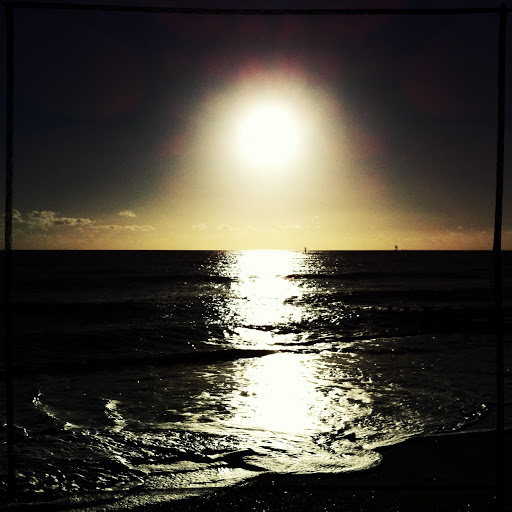
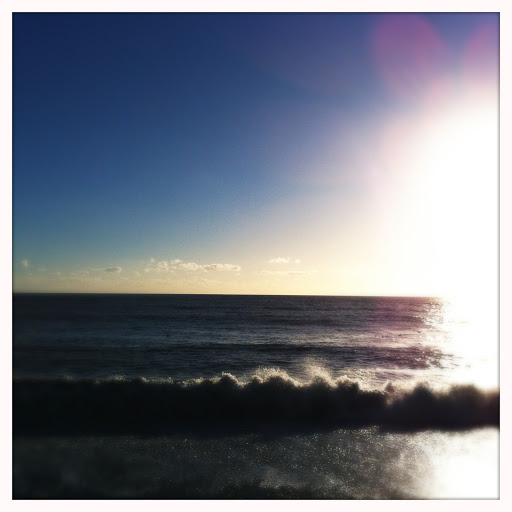
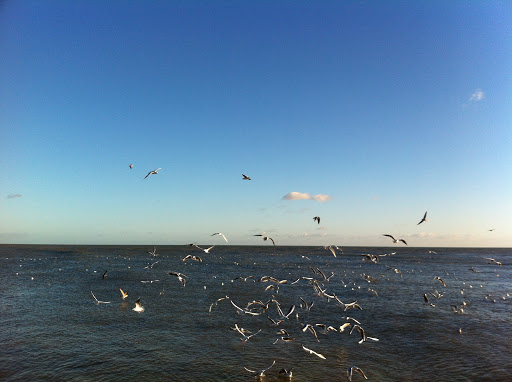
I took these snaps on New Years Day when I went for a walk on Littlehampton Beach – it was a day bright with possibility and made me feel entirely content. I wish you all a wonderful 2013.