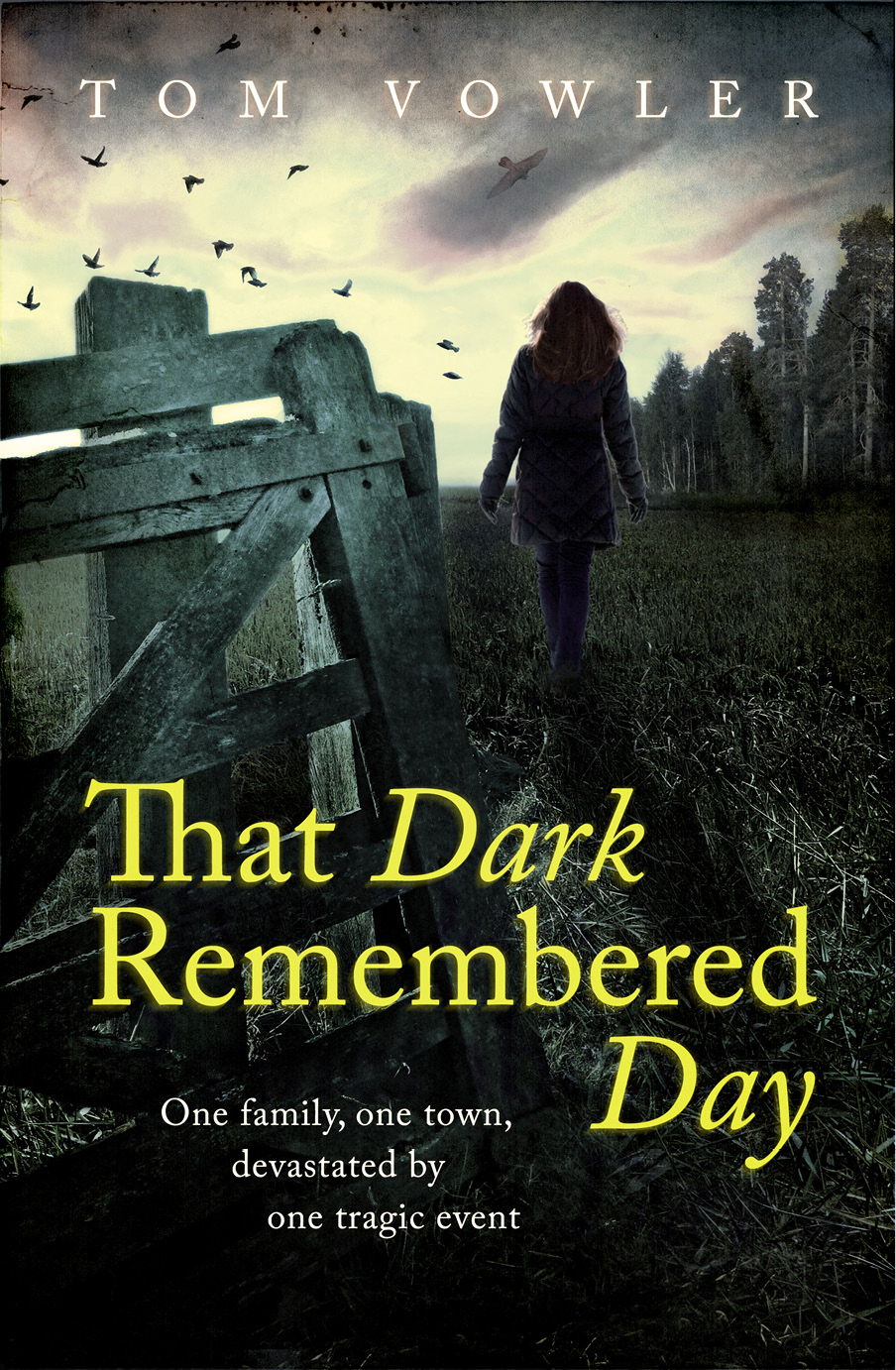
That Dark Remembered Day by Tom Vowler

Vowler has a keen eye for nature and roots us in a landscape whose bleakness matches the dark heart of the story. Stephen narrates the opening and closing of this novel, the middle two parts voiced by his mother and father, and through them we explore a devastating crime. Stephen has returned “home” twenty years on to visit with his ill mother. Driving through the village, drinking in the local pub, walking by the river, he is surrounded by people and memories from the past. His stay forces him to confront what happened and the impact it has had on not only his life, but the lives of all who were there. The dreadful crime at the heart of the story is kept from the reader until the end, unfolding gradually in the telling. I found the mother’s voice the most interesting and wished she could have been allowed more light in a life which seemed impossibly harsh.
This exploration of post traumatic stress woven into a compelling story is a real tragedy.


vowler


Stay tuned for Tom Vowler’s Smash Lits.


A Song for Issy Bradley by Carys Bray


The Bradley family are devout Mormons. Ian is the Bishop, his wife, Claire, converted to the faith before marrying him and together they are bringing up their four children – Alma, Zippy, Jacob and Issy, following stringent Mormon rules. The author was herself, until relatively recently, a practising Mormon, so it’s fair to assume the book is an accurate representation of family life within the faith, with all the accompanying homilies and entreaties.

Bishop Bradley is big on sacrifice and duty, believing his path to heaven is assured just so long as he devotes himself to serving his church and spreading the word. He prioritises church duties over family duties, which is why it’s left to an overstretched Claire to shop for Jacob’s birthday party and organise the food. Her youngest, Issy, is unwell and tucked up in bed, Claire too busy to pay her much attention until it’s too late and tragically she dies.

It’s Bray’s ability to be quietly devastating that makes the story so affecting. Never mawkish or sentimental, she uses humour and a warm understanding of the human psyche to explore each family member’s thoughts and feelings in turn. They struggle to cope with their grief in very different ways. Jacob believes Issy can be brought back to life with his faith. Zippy focuses her attentions on a classmate she fancies, the only other Mormon at her school, one who she hopes will marry her. Alma lives for football and is the most cynical, yet finds unexpected comfort from one of the Brothers at church. Ian throws himself into his ministry and tries to keep home life going when Claire takes to Issy’s bed and refuses to speak or get up. Claire, overwhelmed with a deep depression that goes unrecognised because it wouldn’t be the done thing, questions her faith and waits for a sign from God. (I won’t plot spoiler, but there was a Claire scene that broke my heart and cemented my absolute dislike of Ian.)

Writing about the beach Bray describes, “The track is sandier now, damp and sticky; gritty, like cake mix.” It’s this descriptive power, employing the everyday and and mixing it with insight, which really elevates this novel. The children’s voices all feel accurate – Jacob aged 7: “There are so many kinds of never. There’s the never Mum uses when she says, “Never talk to strangers; it’s dangerous,” and there’s the never Dad uses when he says, “Never play with your food; it’s bad manners.” But Mum talks to plenty of people she doesn’t know, and Jacob has seen Dad break Oreos in half to lick the creamy bit.” These simple contradictions are followed by larger ones. At the centre of it all, the question why Heavenly Father would take Issy.

A wonderful debut, full of heart.


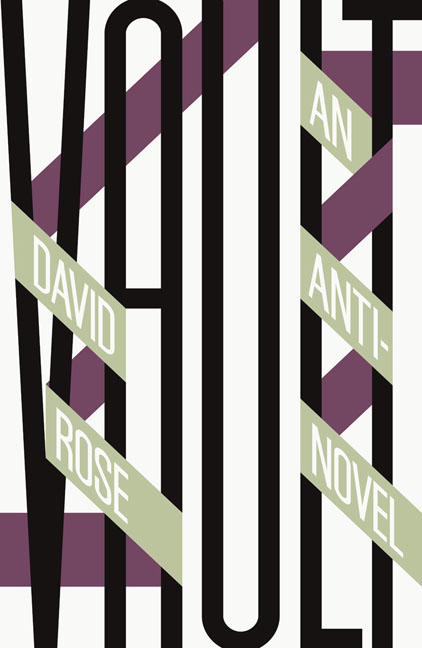
Vault by David Rose

Vault is a compact novel comprising brief chapters marked A or B. The A chapters pertain to a fictionalised version of the narrator of the B chapters. The B chapters are “factual” rebuttals of the novel. No wonder Vault’s subtitle is “An anti-novel”. It sounds complex, but the divisions are smartly done. B is written mainly in clear, clipped prose, whereas A employs (slightly) more flourishes of language.

A cyclist becomes a wartime sniper and afterwards something of a vigilante, and then an unofficial spy. He also falls in love and cycles competitively. That’s a pretty huge range to cover, but there is no padding, no filler in Rose’s writing and the novel is 158 pages.

His character is a loner whose aloofness serves to distance him from those around him, and his readers. Even when describing the love of his life he blankly states: “But this was all a long time ago and, later, she left me.” Nonetheless, the impact of some scenes, I’m thinking of the sniper waiting patiently to kill, and later, after the war, protecting a woman who has received food from an aid station, is heightened by the tightly controlled descriptions.

The cycling sections are beautifully exhilarating and offer welcome relief.

And how wonderful is that cover!

Vault


Rose is clearly a fine writer and I’m looking forward to reading his short story collection – Posthumous Stories, which I’ve just treated myself to.
 

We Need New Names by NoViolet Bulawayo

Of course we should never judge a book by its cover, and yet this cover is so bright and attractive I was drawn to it in a way I wouldn’t have been if it had been one of those beige books. I’m glad to say the novel inside is as vibrant and fresh as the cover suggests.

This is the story of Darling, ten years old and living in Paradise, a place which is anything but. She has friends: Bastard, Chipo, Godknows, Sbho and Stino. They play together, hunt for guavas in the richer area of Budapest, and talk about escaping their shanty town. Always hungry, no longer at school, with the adults around them struggling under a regime that has robbed them of  money, jobs and homes, Darling and her friends nonetheless fizz with energy and fun. People have to leave Paradise to earn money, Darling’s dad included, although he sends nothing back. Then one day he returns home to die. Chipo is pregnant at 11, the result of rape. All the while the sun burns down and the hunger gnaws. Bulawayo is brilliant at describing this and the necessary bravado these children employ.

“I used to be very afraid of graveyards and death and such things, but not anymore. There is just no sense being afraid when you live so near the graves; it would be like the tongue fearing the teeth.”

Darling tells her friends her Aunt will be taking her to America, but when Aunt Fostalina actually does, everything reverses. Sometimes it feels a little obvious – Darling is surrounded by food, but the abundance of food means that people obsess about what to eat and over exercise or starve themselves to be thin enough. Snow falls and Darling is colder than she ever imagined possible and longs for the warmth of Paradise. Darling can never return to Zimbabwe because she has no official papers and becomes consumed by a yearning for home and an insurmountable sense of displacement. She belongs nowhere.

“Because we were not in our country, we could not use our own languages, and so when we spoke our voices came out bruised. When we talked, our tongues thrashed madly in our mouths, staggered like drunken men. Because we were not using our languages we said things we did not mean; what we really wanted to say remained folded inside, trapped.”

Bulawayo highlights how (some) Americans presume Africa is one country and that all parts are the same;

“Oh my God, yes, we’ve seen your country; it’s been on the news.”

Her portrayal of (some) Americans as being obese, porn watching and ignorant is possibly equally unsubtle. What makes all this work so well is the verve of Bulawayo’s language, and the humour that lightens the terrible darkness. The beginning of the novel was originally a short story – “Hitting Budapest” and it propels the reader into another world with wit and speed.

In the last chapter “Writing On The Wall” some of Darling’s original energy reappears, but when she talks to Chipo via Skype, and Chipo lectures her on leaving, it sounded as if perhaps this is the author’s voice, lecturing herself. Darling is an interesting character, I’d love to know what happens to her next, and I’d dare to wish her an almost happy ending, though I’m not sure Bulawayo would think one possible.

Someone Else’s Skin by Sarah Hilary

Sarah Hilary’s Someone Else’s Skin is published on the 27th of this month (by Headline) and it’s a stonkingly good read. I don’t usually read crime fiction, but I do enjoy watching TV detective shows, as does Sarah. (I know this because we have tweeted each other about our love of “Cho time” in The Mentalist, and our admiration for Luther.) Reading S.E.S I was immediately struck by how much like a television drama the novel seemed. I could “see” the story unfold. It has to be made into a TV show, surely?

Marnie Rome and her partner, DS Noah Jake, visit a women’s refuge in the hope of getting one of the women to testify against her brothers. Whilst there, a man is stabbed by his wife in front of several of the residents. As the officers investigate the stabbing, three of the women go missing.

At the same time, Marnie Rome’s backstory is woven in – her parent’s were murdered five years ago, and Rome regularly visits their murderer.

What follows is an intriguing tale where Hilary continually confounds expectations. Rome is allowed weakness, she makes mistakes, gets angry, and has complex emotions. Her relationships with Noah, and victim support worker, Ed Belloc, are well drawn. It’s a novel where nothing is quite as it seems. Hilary is unafraid of exploring darkness and some big issues, but never at the expense of story. It’s all very page-turny, even if I did find some of the violence unpalatable. It’s a well written, pacey, engaging novel, and I really want to know more about Marnie et al and am looking forward to book two. In the meantime, I had a few questions for Sarah which she agreed to answer for me:

Q. You’re an excellent short story writer, how difficult was it to expand into writing novels? Any words of advice for writers hoping to transition from short story writing to novel writing?

A. Thank you, that’s very kind. I enjoy writing short stories but boy, do I find them hard to get right. I think I’m better suited to writing novels; my stories seem to bend towards the shape of a novel more easily. So, in terms of advice, I’d say go with the shape of the story and see where it takes you.

Q. Where did you write? Any routine/ritual etc?

A. I’m very guilty about the fact that I bought a lovely writing desk when I moved house, and haven’t sat there once. I write in cafes. I like the white noise, and the coffee. I make sure I write for at least two hours before I allow myself a break. It’s the only way I can be sure to get it done.

Q. When you started writing did you know you were creating a series?

A. Always. It’s such a gift to be able to spend time with the same characters.

Q. How far ahead have you plotted in terms of story arc?

A. I try to have ideas for the next book along, whenever I’m writing something new. Not plotting, as such, but nuggets.

Q. Have you written book 2 yet?

A. First draft, yes. I’m about to embark on the second draft so wish me luck.

Q. Would you like to see it made into a TV series? And if so, any idea on who would make a good Marnie Rome?

A. That would be amazing, wouldn’t it? A friend suggested Karen Gillan for Marnie, but I’m not sure. I do know that I’d love Ashley Walters to play Noah Jake.

Q. What is your fave tv detective series?

A. Currently? The Bridge. I love Saga and Martin so much it hurts.

Q. Who is your fave tv detective?

A. Saga Norén.

Q. What about crime novels – any favourites?

A. Everything ever written by Fred Vargas. Also, The Collector by John Fowles, and Silence of the Lambs by Thomas Harris.

Q. You write about domestic violence & female genital mutilation – was it always your intention to try to highlight these issues?

A. No. I started out to write a book about secrets, and deceit. The characters I created each had different secrets, and some of those secrets were very dark. But I do want to talk about issues which have been side-lined by society, especially the ones that make us uncomfortable. There’s too much silence born of discomfort, I think. I’d like to make a bit of noise around those issues, because they matter so much.

Q. Did you do much research?

A. Enough to be sure of my facts, but not so much that it strays into non-fiction or gets in the way of the storytelling.

Q. The book is pretty harrowing with some deeply unpleasant violence. How easy was it to switch off and go and cook tea etc?

A. I don’t cook, which helps..! Writing Someone Else’s Skin did stir up a lot of unsettling emotions in me, but I think that’s part of being a writer, isn’t it? Keeping faith with the dark and the light… The chip of ice in our souls, as Graham Greene called it. I’m not very good at switching off; the next story is always percolating in my head. Probably very unhealthy although my editor would approve.

Thank you Sarah. I wish you and Marnie much success.

If you can’t wait to get your hands on Someone Else’s Skin you can preorder here. I’m sure all fans of crime fiction will be delighted to discover such an intriguing new detective.

Cartwheel by Jennifer DuBois

I was sent this book in e-reader format which had no accompanying blurb, so I read with no inkling of what it was about. It begins with a father, Andrew, arriving in Buenos Aires with Anna, his youngest daughter. Lily, his eldest, is in jail accused of murdering her room mate. It is clearly based on the murder in Italy of Meredith Kercher, and the conviction of her fellow exchange student, Amanda Knox.

Amanda Knox inspired page after page of speculation in the Italian, UK and American presses. She was deemed to have behaved inappropriately in the aftermath of the murder and faced “trial by media”. Like Amanda Knox, Lily is examined through her social media pages, messages, photographs and cctv, and judged long before her case goes to court. The story is told through the perspectives of Lily, her father, the prosecutor Eduardo Campos, and Sebastian, the young man she had been casually seeing.

Initially I was impressed. The writing is good enough that it took me a while to realise that despite the occasional interesting psychological insights there’s not an awful lot of substance. It’s as if DuBois skates prettily across the surface of what is actually lurking darkly beneath.

Sebastian’s parents died in suspicious circumstances and left him alone, wealthy and isolated in a sprawling mansion. (I couldn’t fathom any relevance to them being spies) and finds comfort watching the Carrizo house where Lily and Katy are staying.

“Sometimes he imagined that they could see him, too. This fantasy kept him busy and decent, dressed, up at reasonable hours, engaged in activities that were arguably fruitful.”

I liked that very much. It felt as if it could be real whereas in a novel based on reality, not much else did. Sebastian provides another good line when he recalls his father telling him:

“Nobody is really paying attention to you. Most people don’t really get this. They think they must count more to other people than other people count to them. They can’t believe the disregard could truly be mutual. But it’s a useful thing to learn…”

Perhaps this goes against the central theme of the novel which seem to be the idea that we are all being watched, even when we think we aren’t, because our trail of photographs and social interactions can be found and examined if something happens which warrants public scrutiny. Pieces of a puzzle can create a picture that looks like truth but isn’t.

Lily is portrayed well as one of those bright, intelligent, but not quite as unique as she hopes, teens. Isn’t that most of us when we were her age? Katy remains a sketchy “perfect” girl. I had sympathy with Andrew as he struggled to deal with how off kilter his life was. I thought the way he got things wrong, and realised that, made him quite endearing. Sebastian, as we are repeatedly told, suffers from sounding sneering and sarcastic, however, it’s the prosecutor who is the least realistic of the characters. He has an on and off love affair with an erratic woman who serves as a reminder that behaviour can be eccentric, odd, even cruel, without being illegal. Neither his love affair or prosecution convinced me.

Disappointment comes with the realisation that reading Cartwheel is rather an empty experience. It’s a well written book which elevates it beyond a schlocky crime biography –  a literary book I suppose. But that doesn’t stop it being a novel about an actual horrific murder. I think I would need to feel it added some… understanding or something, for it to succeed. As it stands I feel a bit dubious about why it was written.

The Circle by Dave Eggers

For some reason I always link Dave Eggers and Douglas Coupland. Maybe because they have long been my two favourite contemporary male authors. Egger’s latest novel “The Circle” definitely brings to mind “Microserfs”.  The Circle is an exciting, innovative, successful Silicon Valley company. Being employed by them is Mae’s dream job, and she is incredibly grateful to her best friend, Annie, for getting her into the organisation. We see the enticing offices through Mae’s eyes as she is given her introductory tour, taking in the freebies on offer, the glitzy, glamorous setting, the fun, the youth, the talent. She settles into her role answering online queries, determined to meet the high grade challenge on customer satisfaction and push herself ahead.

Her job quickly develops, and she keeps pace with additional screens and requests. She’s enthusiastic and happy. She socialises on the work campus, sometimes she even sleeps in one of the dorms. The Circle seems to be modelled on Google and Facebook. It integrates all internet activity so that it runs zings (tweets), searches, financial transactions, tracking, and beyond. Mae meets a guy who is doing interesting work in the field of child security. The company aims for some unclear “completion”. Its ethos is very much one of transparency, and it sets up cameras all over the world, constantly recording, reporting, watching.

“If you aren’t transparent, what are you hiding?”

All employees are given health monitors they wear on their wrists. The company cares for them. The company cares for all, including Mae’s dad who has MS and who the company begins to treat, putting up cameras all over her parent’s house to continually monitor him.

As I read I realised how Facebook began to automatically download pictures from my iPhone recently, and how Spotify shares information about what music I listen to. How I’m wearing a FitBit flex, not a million miles away from a health bracelet. How easy it is to know such a lot about me via Google. I have always been equal parts blasé and cautious about the information I share. Or, at least, I had supposed I was. Reading this made me want to immediately delete my social media profiles and run the hell away from the internet. But that moment passed, and I facebooked how I liked this book, and I’ll tweet this blog post, and I’ll post my review on waterstones.com.

Mae’s ex says to her:

“No one needs the level of contact you’re purveying. It improves nothing. It’s not nourishing. It’s like snack food.”

This is true. It seems harmless, but is it? We watch as Mae gets sucked deeper into The Circle, and we hope that she’ll be ok.

I really enjoyed this novel. The ex who likes to make one off pieces of art seemed a wee bit of an obvious foil to the giant corporation, and Annie’s heritage sounded like a clear plot device to me the second it was mentioned, but they are minor niggles about what is not only an engaging story, but a thought provoking read.

Read it and delete.

Unexploded by Alison MacLeod

Image

Set in Brighton and spanning the period of May 1940 – June 1941 “Unexploded” is obviously a story about war. It is, however, a deliciously layered novel whose strength is in its dealings with smaller more personal wars as well.

The novel leads us through the streets of Brighton, pointing out landmarks and features. Hitler is expected to invade and MacLeod is illuminating on the resultant atmosphere:

“Fear was an infection – airborne, seaborne – rolling in off the Channel, and although no one spoke of it, no one was immune to it.”

Evelyn, Geoffrey and their son, Phillip, live in the heart of Brighton. They are the very picture of respectability. Geoffrey is a banker who has been selected to take charge of Brighton’s internment camp. Evelyn is a well to do woman, unused to running the house without staff, but muddling along.  She married Geoffrey “…for his intelligent kindness, for his sense of fairness, for his loyalty to people.” We begin by sharing her impression of Geoffrey as a moralistic and trustworthy pillar of the community, and then watch that impression shatter.

Unexploded continually subverts preconceptions.

Evelyn takes it upon herself to read to the sick prisoners at the camp and encounters Otto Gottlieb, a “degenerate” German-Jewish artist. He is objectionable and hostile, and yet eventually shows more humanity than Geoffrey.

The evocation of wartime suspicions is superbly done. The children that Philip play with secretly listen to Lord Haw-Haw and anticipate Hitler’s arrival with a thrill. Anti-Semitism is rife, suspicion everywhere. A playmate’s older brother has been damaged forever in the war. Phillip’s friend wants revenge for him. Games turn ever more dangerous.

As Geoffrey and Evelyn’s relationship disintegrates both form attachments to others. There is much bubbling underneath. Evelyn seeks solace and wisdom in literature and particularly in the words of Virginia Woolf. (In yet another smashed preconception she sees her butcher attending a Woolf lecture.) Otto pays tribute to the dead through his paintings. The Arts are a vital life force.

I was already a fan of Alison MacLeod’s writing before I began reading Unexploded.  I am even more so now. Her words resonate, her descriptions are clear, her ability to imagine small details transport the reader. She expertly moves the story through to its climax, and beyond. Thoroughly deserving of its Booker longlisting, this is a thought provoking and engaging novel.

Tampa by Alissa Nutting

Tampa is a novel that is shocking and provocative. The cover and the opening line make that clear, just in case the reader was in any doubt.

“I spent the night before my first day of teaching in an excited loop of hushed masturbation on my side of the mattress, never falling asleep.”

Twenty-six year old Celeste Price is extremely beautiful, married to a police officer called Ford who has plenty of family money to lavish on her, and is about to embark on her first teaching job. A job she has trained for simply to enable her to have access to the male students. Celeste is sexually insatiable, and her predilection is for fourteen year old boys. Fourteen because by fifteen they are already aging.

She is in a fevered state of arousal at school. She masturbates alone in her classroom. From the outside she appears to be in control of her students and ostensibly teaches them English, but all the while she is selecting an appropriate victim. He has to have disengaged parents, be quiet enough not to boast about having sex with his hot teacher, and look appropriately young. She picks Jack Patrick.

Nutting’s writing is crisp and clear. She has a good eye for detail, describing one woman as having a “caffeinated ponytail, which was perched in the top center of her skull like a plume on the hat of a Napoleonic infantryman.” but the many graphic sex scenes are written in a blankly detailed way. When Celeste is not having sex with Jack she is fantasising about him and masturbating, or maybe enduring sex with Ford. I won’t spoiler any plot developments, but we read many of these unemotional and ultimately rather dull scenes. 

The characters don’t have depth – we don’t ever learn much about Jack or Ford – we see them only through Celeste’s eyes. Celeste is a vain woman with a one track mind. Nutting does not make her in any way a sympathetic character, but she is darkly humourous. A fellow teacher, Janet, serves as her counterpoint. Where Celeste is young and attractive, Janet is jaded and unattractive. The staff don’t like her, the kids don’t like her. Celeste attracts colleagues and students alike with her beauty and is able to continue her predatory behaviour, whilst Janet repels them.

This is Nutting’s point, I think. She wants us to look at how society treats beautiful women differently to plainer ones, and female paedophiles differently to male paedophiles. The title Tampa refers us to the Debra LaFave case, where LaFave, a stunning 26 year old teacher, pleaded guilty to “Lewd or Lascivious Battery” after having sex several times with a fourteen year old student. Her lawyer argued that she was too attractive to go to prison. On seeing pictures of her, many thought the boy had been lucky. (Nutting went to the same school as LaFave.) I’ve been googling, and sadly LaFave is far from alone. Sex with a child is a terrible criminal act, no matter who commits it. Consent from a child is no consent at all. 

Society is often dazzled by shiny, pretty youth. This novel boldly shines a light on some big, messy contradictions. 


Sisterland by Curtis Sittenfeld

A new Sittenfeld novel is always a treat, and Sisterland is a beautifully absorbing read. It’s one of those books that you can’t wait to get back to when you have to put it down, and then feel bereft when it’s finished. In fact, I haven’t yet been able to get on with the next book in my tbr pile, it’s too soon.

Kate wants a quiet, normal life. She’s a stay at home mum to Owen and Rosie, is happily married to Jeremy, and spends her days on playdates with friend and neighbour, Hank, and his daughter. Hank is married to Courtney, a professor of geophysics, who works with Jeremy. The two couples socialise together, pop in and out of each others houses, and have a good relationship. When Vi, Kate’s identical twin sister, appears on TV predicting a catastrophic earthquake, it’s Courtney who appears opposite her, ridiculing her claim and offering a coolly scientific point of view. Fissures appear in all of their lives.

Where Kate is anxious, controlling and rigid, Vi is expansive, spontaneous and impulsive. Sittenfeld manages to make the reader empathise with both of them. Vi looks like she’s having more fun maybe, but I identified with the mummy angsting of Kate. Both twins have always had “senses” although having been ostracised in high school because if her ability to tell the future, Kate has long since attempted to ignore any feelings she has. She’s furious with Vi for the publicity which surrounds her announcement, and fears that she will be identified as Vi’s twin, and therefore be seen as creepy and different, once again. Loathe as she is to play any part in the prediction a date suddenly fixes itself in her mind, and she feels she has to tell Vi.

Sittenfeld is a classy writer and a great observer of people. The psychic parts are underplayed and seem nothing much more than the general feelings we all get from time to time – this is no schlocky paranormal story. Instead, we are treated to many telling details and conversations.

“Are you embarrassed to be married to me?” I’d thought I was making a joke, but aloud it didn’t sound like one.

Sittenfeld expertly sweeps us back and forth in time, creating entire lives. We learn about the twin’s parents, their depressed mother and apparently somewhat clueless dad, we learn about school, first boyfriends, friendships, jobs, partners. It’s the same skillful layering that was employed so well in American Wife. And all the while tension builds as we approach the dreaded date of the predicted earthquake. It’s another pageturner, and Sittenfeld has proven once again that she’s one of the very best storytellers around.