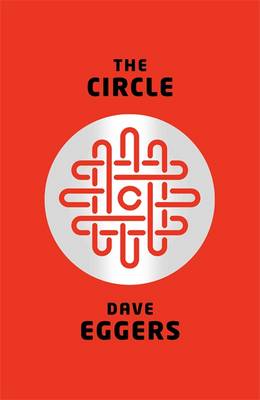
The Circle by Dave Eggers

For some reason I always link Dave Eggers and Douglas Coupland. Maybe because they have long been my two favourite contemporary male authors. Egger’s latest novel “The Circle” definitely brings to mind “Microserfs”.  The Circle is an exciting, innovative, successful Silicon Valley company. Being employed by them is Mae’s dream job, and she is incredibly grateful to her best friend, Annie, for getting her into the organisation. We see the enticing offices through Mae’s eyes as she is given her introductory tour, taking in the freebies on offer, the glitzy, glamorous setting, the fun, the youth, the talent. She settles into her role answering online queries, determined to meet the high grade challenge on customer satisfaction and push herself ahead.

Her job quickly develops, and she keeps pace with additional screens and requests. She’s enthusiastic and happy. She socialises on the work campus, sometimes she even sleeps in one of the dorms. The Circle seems to be modelled on Google and Facebook. It integrates all internet activity so that it runs zings (tweets), searches, financial transactions, tracking, and beyond. Mae meets a guy who is doing interesting work in the field of child security. The company aims for some unclear “completion”. Its ethos is very much one of transparency, and it sets up cameras all over the world, constantly recording, reporting, watching.

“If you aren’t transparent, what are you hiding?”

All employees are given health monitors they wear on their wrists. The company cares for them. The company cares for all, including Mae’s dad who has MS and who the company begins to treat, putting up cameras all over her parent’s house to continually monitor him.

As I read I realised how Facebook began to automatically download pictures from my iPhone recently, and how Spotify shares information about what music I listen to. How I’m wearing a FitBit flex, not a million miles away from a health bracelet. How easy it is to know such a lot about me via Google. I have always been equal parts blasé and cautious about the information I share. Or, at least, I had supposed I was. Reading this made me want to immediately delete my social media profiles and run the hell away from the internet. But that moment passed, and I facebooked how I liked this book, and I’ll tweet this blog post, and I’ll post my review on waterstones.com.

Mae’s ex says to her:

“No one needs the level of contact you’re purveying. It improves nothing. It’s not nourishing. It’s like snack food.”

This is true. It seems harmless, but is it? We watch as Mae gets sucked deeper into The Circle, and we hope that she’ll be ok.

I really enjoyed this novel. The ex who likes to make one off pieces of art seemed a wee bit of an obvious foil to the giant corporation, and Annie’s heritage sounded like a clear plot device to me the second it was mentioned, but they are minor niggles about what is not only an engaging story, but a thought provoking read.

Read it and delete.
The Deaths by Mark Lawson

Four wealthy families live in four exclusive listed houses in the countryside, a half hour commute from London. From the outset we know that one of these families has been murdered, and Lawson’s novel keeps the big reveal of who and why until the end part of the book. Instead he introduces us to each of “The Eight” as they commute, work, shop, drink, eat, and holiday together. On the surface all is perfect, inevitably, not far beneath those glossy veneers, all is far from ok.

The difficulty with having four sets of couples is in establishing distinct personas for each. Max, Jenno, Emily and Jonny seemed more vivid to me than Simon, Tasha, Libby and Tom. Added to their voices are those of the children, Nick (a fellow commuter), the investigating police officers, a female vicar, a nanny. Lawson’s cast is large, as is the novel, and I don’t think he manages to capture all the voices. His attempt at teen speak is rather clunky:

“Jeez, this is awks… He’s really old (thirty?) but dead fit and definitely gives her the full body scan, even though Mumsie made her wear a body-burka and what she calls the Sensible Coat. Tilly was, like, I’ll be inside all day but she was only on transmit as usual. Troll.”

He does, however, excel at pompous men whose speech is still peppered with juvenile public school phrases.

It’s not really a murder mystery, although of course it is that; it’s a satirical look at life now, a social commentary for the middle aged. Smart phones, Waitrose, drinking too much, children speaking in faux gangster styles, the economy, hypochondria, internet porn, coffee culture and so on. There are funny lines such as “Simon blames Top Gear for the fact that so many British men now regard conversation as violently belittling banter.” There’s also a lot of sex talk, and some sex scenes that may surely be nominated for this years Bad Sex award. (I can’t be bothered to flick back through the whole book, but I think there’s even a reference to the penis as truncheon.)

I wanted to know what had happened, but I did become somewhat bored and took to skim reading occasionally. It’s all a bit of a romp, with some brilliantly well observed lines skewering the white, middle classes. My favourite line:

 “A black maid is doing something complicated with pastry. The lives of these people.

“Monifa, my wife,” Mortimer identifies her.

Kate tries not to show that she has been humiliatingly out-liberaled.”

Stoner by John Williams

Image

Several weeks ago people began to come into the bookshop and ask for Stoner. We got so many requests we kept it by the counter within easy reach. Initially I figured the title referred to some marijuana puffing dude, a paean to slackerdom, but I was entirely wrong. Stoner is a novel originally published in 1965, recently reissued by Vintage Classics. William Stoner is the name of the main character, a character not too dissimilar to the author, John Williams, apparently. It went into our “buy one get one half price” offer, and yet more people have bought it. I think part of the interest is that few people have heard of Williams, the novel is touted as a “forgotten classic”, and we all like the idea that we’re rediscovering something amazing.

From the first page we know that Stoner is the story of one man’s unremarkable life.

…he did not rise above the rank of assistant professor, and few students remembered him with any sharpness after they had taken his courses.

Stoner’s colleagues, who held him in no particular esteem when he was alive, speak of him rarely now; to the older ones, his name is a reminder of the end that awaits them all, and to the younger ones it is merely a sound which evokes no sense of the past and no identity with which they can associate themselves or their careers.

William Stoner is the son of poor farm folk. From an early age (six) he becomes used to hard work and is expected to take over the running of the farm one day. He has no plans to ever leave the farm, but his father surprises him by sending him to college to study agriculture and the “new ideas” for four years. At college Stoner discovers what will be a lifelong interest in literature. For me, the books most devastating moments are those between Stoner and his parents. The writing is so understated, the prose so calm and clear. It’s incredibly moving.

Stoner remains at the university. The one constant in his life is literature; he studies, teaches, writes. He marries a woman who seems only to exist to make his life a misery. My one criticism of the novel is how it is never explained quite why Edith is so unpleasant, not only to him, but also to their daughter.

Where the novel succeeds beautifully is in its depiction of sheer ordinariness. Although Stoner occasionally glimpses something more, be it in his work, or as a father, or in love, those glimpses, those moments of hope, quickly fade. Stoner is left with the disappointment of being human. The reader understands this only too well.

…she would live her days out quietly, drinking a little more, year by year, numbing herself against the nothingness her life had become.

I really did care about Stoner. For all its quietness there are plenty of life events to keep the pages turning. Well deserving of its “classic” status, this is a book I’m thrilled is selling so well. How marvelous, and what a shame John Williams couldn’t know how popular this novel would become. That’s very Stoner-ish.